September 2026 Volume 24 Issue 9
|
We are a voice for our small town, grassroots members who may otherwise not have access to the right audiences, as well as a conduit for industry to come together in support and promotion of transportation improvements.
We are committed to working as an Alliance to improve transportation infrastructure and business networks opportunities, by advocating for appropriate funding levels, so business and industry can thrive.
We are focused on the economic and business interests that are the lifeblood of the region.
|
Be Sure Newsletter Email is Allowed
|
As you may have noticed, the monthly Ports-to-Plains Newsletter is sent through our member database. Please be sure the email address pal@memberclicks-mail.net is allowed on your system.
|
As we enter the last quarter of this year, I am reminded of two significant events that our country celebrated, our 250th anniversary and the 70th anniversary of our Interstate Highway System. If you were able to attend our conference you heard me talk about the sustainability of three ancient world civilizations comparing the age of our country to the Persian, Greek and Roman Empires. We are approaching the age of the first two, but we need to exist for another 1200 years to match that of the Roman Empire. All three had strong militaries and stable forms of government, but the vast Roman Road network differentiated it from the other two that helped sustain its greatness for fourteen centuries.
Now in our 250th year we find ourselves celebrating the 70th year of the Eisenhower Interstate Highway Act. A bill that sparked the construction of over 47,000 miles of interstate highway connecting the east coast with the west and points in-between. And outside of the mistakes of not providing adequate access to some small communities or adverse impacts to some urban neighborhoods, the interstate system that we have today was and is a powerhouse generator to our nation’s economy and wellbeing.
|
But what about the next 250 years? What do we need to do with our national infrastructure to ensure sustainability like the Roman Empire? For the last 30 years we have done nothing but maintenance on our interstate system. The time to take our Interstate Highways to the next level is now! Congress is currently looking at the reauthorization of the Surface Transportation Bill. A bill that hopefully gets renewed every five years. Two items that need to be addressed will be the modernization of our existing interstate, and the completion of the gaps (particularly the north-south gaps) in the national system. That is the purpose of the Congressionally Authorized Future Interstate (CAFI) coalition. When you hear about CAFI, now you know what we are trying to accomplish. This doesn’t just help the Ports-to-Plains with our three high-priority corridors. This is good for our whole nation, helping us maintain that greatness that we have been accustomed to expecting.
I would like to close this article by recognizing the life of my predecessor and former President of the Ports-to-Plains Alliance, Michael Reeves. I know we have a tribute for Michael later in our newsletter, but I would like to share my condolences to Michael’s family who shared Michael with our organization for many years. The accomplishments of any organization are built on the foundations of many people who have come before us, and Michael added his mark to our advocacy efforts. I remember working with Michael during my TxDOT District Engineer days in Odessa when the Ports-to-Plains efforts were trying to get off the ground. Thank you, Michael.
Next month I want to share with you our “57 to 27” campaign and the impact that improving Mexico Highway 57 will have on our trade corridor.
more to come …
Lauren D. Garduño
|
Remembering Michael Reeves: A Lasting Legacy at Ports-to-Plains
|
Honoring his leadership and service as President and CEO, 2004–2018
The Ports-to-Plains Alliance mourns the passing of Michael Scott Reeves, who died September 24, 2026, at age 57. As President and CEO from 2004 to 2018, Michael devoted 14 years to bringing communities together around a shared vision: better transportation connections and greater economic opportunity across North America’s agricultural and energy heartland.
A Lubbock native, Michael graduated from Coronado High School and earned his journalism degree from Texas Tech University in 1991. After nearly a decade with the Lubbock Chamber of Commerce, he brought his experience in governmental affairs and community advocacy to Ports-to-Plains.
Michael understood that the corridor’s importance reached far beyond the pavement. For farmers, ranchers, energy producers, and businesses, reliable transportation meant access to customers, opportunities for growth, and stronger local economies. He described trade as “a lifeline for our communities,” making a clear case for connecting the region’s productive capacity with markets across North America.
Throughout his tenure, Michael worked to strengthen relationships with state departments of transportation and build partnerships in Canada and Mexico. Those efforts helped unite communities across state and international boundaries around common transportation priorities.
He also carried the concerns of rural communities to Washington DC, advocating for federal funding and policies that recognized the importance of corridors spanning multiple states. Michael understood the value of local voices and encouraged direct participation by Alliance board members, helping lawmakers see how transportation decisions affected the communities they represented.
Under his leadership, Ports-to-Plains strengthened its international relationships and built momentum for extending Interstate 27. Conferences in Medicine Hat, Alberta, and Del Rio, Texas–Acuña, Coahuila, demonstrated the reach of the Alliance and the shared commitment of its partners. That work helped lay the foundation for the corridor’s continuing progress. In 2019, Michael received TxDOT’s Texas Road Hand Award in recognition of his transportation advocacy and work with Ports-to-Plains. The honor acknowledged his years of service to a mission that required persistence, cooperation, and a long-term commitment. Although his tenure concluded in 2018, Michael’s contributions remain part of the Alliance’s continuing story. Advancing a major transportation corridor requires years of relationship building, planning, and persistent advocacy. His work helped establish a foundation on which others continue to build.
As the Alliance advances Future Interstate 27 and the broader Ports-to-Plains corridor, we honor Michael with gratitude for his leadership, his service, and his commitment to the communities of the region. His legacy lives on in the partnerships he helped strengthen and the shared vision he helped carry forward.
The Ports-to-Plains Alliance extends its deepest sympathy to Michael’s family, friends, former colleagues, and all who knew him. We join them in mourning his loss and remembering his contributions with appreciation and respect.
Read Michael’s full obituary and service information.
|
Partnership Study Measures the Full Economic Value of Corridor Investment
|
Completing the Ports-to-Plains Corridor to Interstate standards would deliver substantial economic benefits across nine states, supporting businesses and workers during construction while strengthening the region’s economy for decades afterward.
The Ports-to-Plains Alliance’s economic impact resources bring together regional findings and state summaries for Colorado, Montana, Nebraska, New Mexico, North Dakota, Oklahoma, South Dakota, Texas and Wyoming. The analyses use economic modeling from Regional Economic Models, Inc. (REMI), supported by transportation research and data from North Dakota State University’s Upper Great Plains Transportation Institute (UGPTI). Over the next few months, state reports will be highlighted. See below for Texas and North Dakota.
Across the nine-state corridor, an estimated $75.46 billion in construction investment is projected to generate $175.81 billion in economic output, contribute $97.82 billion to gross domestic product, and produce $76.01 billion in personal income. Construction-related activity is also projected to generate $8.15 billion in state tax revenue, with benefits extending to suppliers, local businesses and households throughout the region.
The economic gains would continue after construction. By 2080, improved transportation efficiency is projected to support 59,057 additional jobs above the baseline forecast and $36.67 billion in additional annual economic output. Cumulative state tax revenue attributable to transportation-efficiency improvements is projected to reach approximately $23.73 billion during 2055–2080.
These projections reflect the value of connecting agricultural and energy-producing regions, manufacturing centers, rural communities and international trade gateways. Lower transportation costs and more reliable travel would help businesses reach markets while improving access and opportunity throughout the Great Plains.
The findings also strengthen the case for coordinated federal investment. The Alliance continues to advocate for a multi-state feasibility study north of Texas and New Mexico, additional Future Interstate designation and I-27 route numbering, and predictable formula funding to advance construction.
Construction costs are planning-level estimates incorporating 3 percent annual inflation over an assumed 25-year construction period. Actual costs and economic outcomes will depend on project conditions and implementation.
Explore the economic impact findings and download your state’s report.
|
Record-Setting 2026 Conference: Celebrating Partnerships and Moving from Designation to Delivery
|
Thank you for joining us in Del Rio, Texas, and Ciudad Acuña, Coahuila, for the 2026 Ports-to-Plains Alliance Annual Conference.
With 345 registered participants, this year’s conference was the largest in the Alliance’s history. Government officials, transportation professionals, business leaders and community representatives from Mexico, the United States and Canada came together to discuss the infrastructure, policies and partnerships needed to move the Ports-to-Plains Corridor and Future Interstate 27 from designation to delivery.
Your participation, questions and ideas made the conference a tremendous success. We are especially grateful to our speakers, moderators, sponsors, exhibitors, host communities and volunteers for sharing their expertise and making this binational event possible.
Conference Presentations, Videos and Photos
Conference presentations, session videos and event photographs are being made available on the 2026 Annual Conference webpage. We encourage you to revisit the sessions, share these resources with your colleagues and continue the conversations that began during the conference. We will continue to add to this page as materials become available.
Thank You to Our Speakers and Sponsors
Please join us in recognizing the outstanding conference speakers who provided valuable insight into transportation, trade, economic development, border security, technology and the future of the corridor.
We also extend our sincere appreciation to our conference sponsors. Their generous support made it possible to offer an exceptional conference experience and bring together leaders from across the Ports-to-Plains region.
Professional Development Hours
Transportation, engineering, planning and other professionals are reminded to document their conference participation and apply for any professional development hours available through their licensing or certifying organization. Please retain the conference agenda and your attendance information as supporting documentation.
Thank you again for helping make the 2026 Ports-to-Plains Alliance Annual Conference a record-setting event. We look forward to building on the partnerships, ideas and momentum created in Del Rio and Ciudad Acuña as we continue working together to deliver a safer, stronger and more connected North American transportation corridor.
Add your name as supporting our advocacy efforts by becoming a member of the Ports-to-Plains Alliance. Information on Membership.
|
57 to 27: Connecting Mexico, the United States and Canada Through the ASREC Corridor
|
Connecting Mexico’s Highway 57 with Future Interstate 27 is a key part of the Ports-to-Plains Alliance’s vision for a secure, reliable transportation corridor linking Mexico, the United States and Canada.
During the Alliance’s 2026 Annual Conference in Del Rio, President and CEO Lauren Garduño and Alberta MLA Shane Getson discussed the “57 to 27” strategy and the role of ASREC—Advancing Secure, Redundant, and Economic Corridor—in moving that vision from designation toward delivery.
|
The strategy would strengthen connections between Highway 57, which serves Piedras Negras, Coahuila, and the Future I-27 system in the United States. The broader corridor vision extends north through the Heartland Expressway and Theodore Roosevelt Expressway toward Canada, connecting agricultural, energy, manufacturing and distribution centers with international markets.
An additional major north-south route west of I-35 and east of I-25 would provide alternatives when existing corridors face congestion or disruptions. It would also improve access to major east-west Interstates and support trade throughout the central and western United States. Connecting freight gateways directly to the corridor is central to the ASREC framework. Potential ASREC Ports include land, maritime and inland ports, rail terminals, air cargo facilities and intermodal logistics gateways. The Alliance’s criteria emphasize connectivity to Future I-27, international trade, multimodal transportation, security, resilience and economic development.
One project discussed was Puerto Verde, a planned international trade crossing between Piedras Negras and Eagle Pass, Texas. The project has received a Presidential Permit. According to the Alliance’s announcement, Puerto Verde has also entered into an agreement with Mexico’s federal government involving more than $2 billion in investment to improve Highway 57 to Interstate standards.
|
20 Coahuila Municipalities Unite to Advance Ciudad Acuña–Torreón Corridor
|
A shared vision for stronger transportation connections and expanded economic opportunity took an important step forward during the 2026 Ports-to-Plains Alliance Annual Conference.
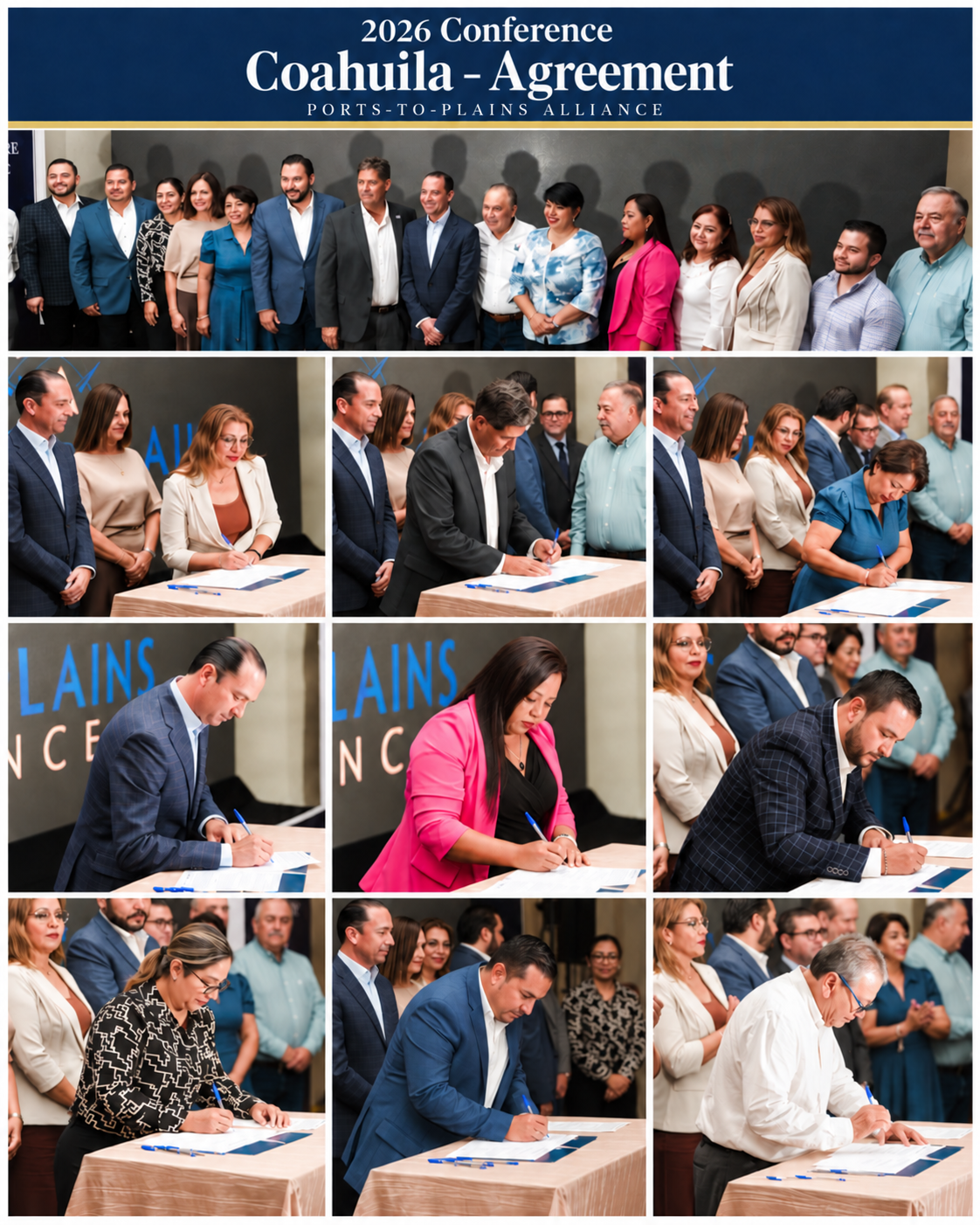
Nearly 300 government, transportation, business and community leaders gathered in Ciudad Acuña on September 9 for a program highlighted by the signing of an Intermunicipal Memorandum of Understanding to advance the Ciudad Acuña–Torreón Multimodal Highway Corridor. The agreement brings together 20 Coahuila municipalities to coordinate infrastructure planning, trade and economic development. “This agreement brings 20 Coahuila municipalities together around a shared vision for safer transportation, stronger supply chains and expanded economic opportunity,” said Lauren Garduño, President and CEO of the Ports-to-Plains Alliance.
The corridor provides an essential connection between Mexico’s industrial and commercial centers, the international border and the Future I-27 corridor. The agreement establishes a framework for modernizing, expanding and preserving highway infrastructure while attracting investment, strengthening supply chains, expanding commercial opportunities and promoting tourism among Mexico, the United States and Canada.
Technical working groups will address infrastructure, logistics, mobility and economic development. The agreement also calls for information sharing, coordinated roadway safety efforts and the promotion of public and private investment in highway and logistics projects. Witnesses signing the agreement represented all three countries. They included Coahuila Secretary of Economy Luis Eduardo Olivares Martínez; Garduño; Del Rio Mayor Al Arreola; Lubbock Mayor Mark McBrayer; Lubbock County Judge Curtis Parrish; and Alberta MLA Shane Getson, Parliamentary Secretary for Economic Corridor Development.
Acuña Mayor Emilio Alejandro de Hoyos Montemayor emphasized the importance of these connections for families and future generations. “We share much more than geography,” he said, highlighting transportation’s role in improving quality of life and connecting the region to North America.
The signing complemented a full day of conference discussions on cross-border trade, the Del Rio Port, manufacturing, investment, nearshoring and reshoring, and international supply chains.
The MOU is a declaration of intent with an initial four-year term. It establishes technical committees to coordinate future initiatives with the Government of the State of Coahuila and the Ports-to-Plains Alliance, providing a structure for communities to turn shared priorities into coordinated action.
Link to Ports-to-Plains Alliance press release, September 15, 2026
|
North Dakota Corridor Improvements Promise Lasting Economic Benefits
|
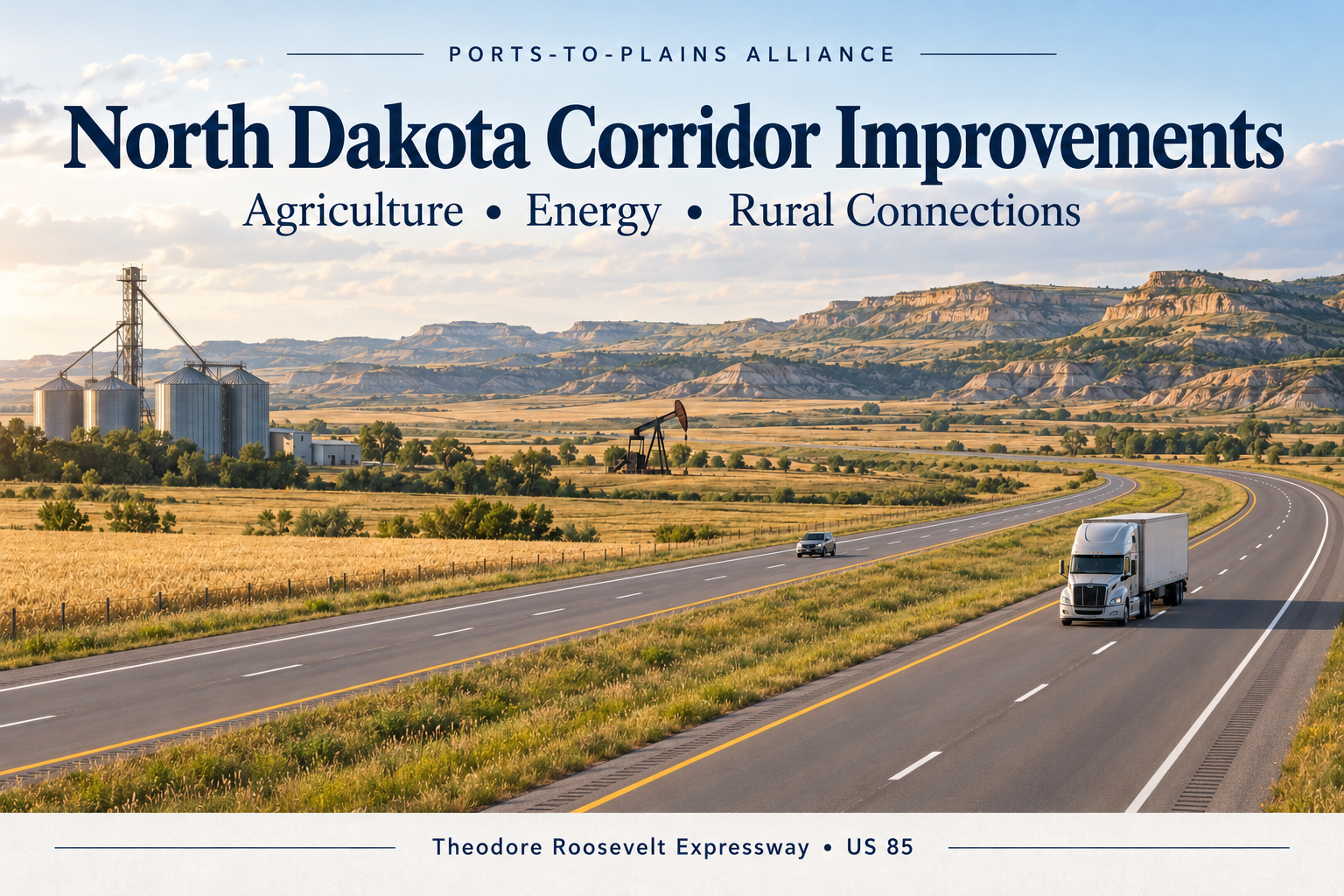
Upgrading North Dakota’s approximately 197-mile Ports-to-Plains corridor would strengthen connections for agriculture, energy and rural communities while improving safety and freight reliability. Following the Theodore Roosevelt Expressway through western North Dakota, the route links producers with I-94 and markets across the broader nine-state corridor.
A preliminary $3.25 billion construction investment is projected to generate $7.51 billion in statewide economic output, contribute $4.12 billion to GDP, and produce $591.7 million in state tax revenue during construction.
Benefits would continue as improved transportation lowers costs and expands market access. By 2080, the analysis projects $822 million in additional annual economic output and 1,765 jobs above the baseline forecast. Cumulative state tax revenue from transportation-efficiency gains is projected to reach $1.20 billion over 2055–2080.
|
The Alliance supports continued US 85 improvements, a multi-state feasibility study, Future Interstate designation and route numbering, and predictable federal funding. Coordinated planning and phased construction would help turn individual projects into a continuous, safer and more reliable north-south corridor.
Link to: North Dakota Ports-to-Plains Interstate Corridor Advocacy Brief, 2026
|
New Economic Studies Highlight Potential of Texas’ I-27 Corridor
|
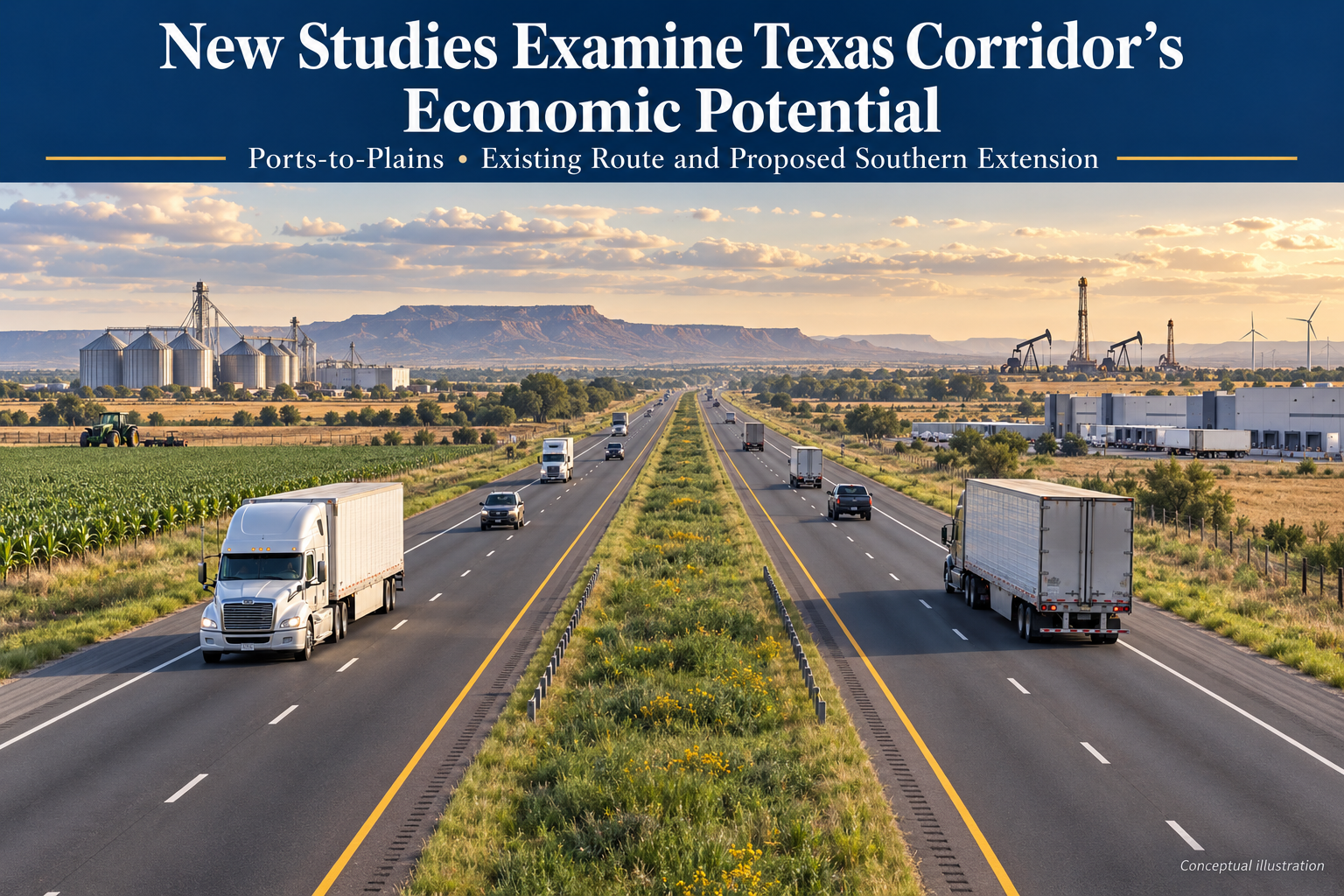
New economic briefs examine the potential impacts of upgrading Texas’ Ports-to-Plains corridor to Interstate standards, including a combined scenario covering the existing route and a proposed extension toward the Rio Grande Valley.
For the approximately 920-mile combined corridor, the analysis projects $99.33 billion in statewide economic output and $55.18 billion in GDP during construction, based on a preliminary $42.09 billion construction investment.
Transportation-efficiency benefits would continue after construction. By 2080, the combined scenario projects $23.51 billion in additional annual economic output and 34,323 additional jobs, compared with the baseline forecast. Cumulative state tax revenue from these improvements is projected at $12.28 billion during 2055–2080.
|
Joe Kiely
Vice President of Operations
Ports-to-Plains Alliance
PO Box 758
Limon, CO 80828
Cell: (719) 740-2240
joe.kiely@portstoplains.com
|
Cal Klewin
Executive Director
Theodore Roosevelt Expressway Association
PO Box 1306
Williston, ND 58802
701-523-6171
cal@trexpressway.com
|
Deb Cottier
Chair
Heartland Expressway Association
c/o TCD
1820 Broadway
Scottsbluff, NE 69341
308-430-5959
dcottier@gpcom.net
|
|