December 2025 Volume 23 Issue 12
|
We are a voice for our small town, grassroots members who may otherwise not have access to the right audiences, as well as a conduit for industry to come together in support and promotion of transportation improvements.
We are committed to working as an Alliance to improve transportation infrastructure and business networks opportunities, by advocating for appropriate funding levels, so business and industry can thrive.
We are focused on the economic and business interests that are the lifeblood of the region.
|
Be Sure Newsletter Email is Allowed
|
As you may have noticed, the monthly Ports-to-Plains Newsletter is sent through our member database. Please be sure the email address pal@memberclicks-mail.net is allowed on your system.
|
It is amazing to me that we are closing out another year working on the three High Priority Corridors that make up the Ports-to-Plains Transportation Alliance. What is even more amazing to me is that I have completed three years with this organization and I am looking forward to number four. I hope that you know by now that I have from day one always tried to frame our mission by trying to answer the why questions. Why is it important for you to join our advocacy efforts? Why is it important for our state DOTs to build these corridors? And why is it important for our political delegations to support these efforts? Because of what is ahead of us in 2026, I want to devote the rest of this article discussing this third why of political support that will be needed to get our project across the goal line.
History has shown that investment in infrastructure and better roads in general has proven to be a bi-partisan issue. There are no blue roads, there are no red roads, there only are better roads. Even when it comes to raising the funds to pay for infrastructure improvements, those efforts usually are successful. Our current political environment, however, will eliminate the opportunity to introduce any kind of funding increase that would be needed to fix our current infrastructure deficits. But we do have an opportunity to influence the political will to do more with what it currently has when it comes to infrastructure investment.
|
I would like to give you an example to sell my point. I used to think that as I worked on my career, it was all about making as much money as I could so that I could live a comfortable lifestyle with all the perks afforded with that type of income. I have since discovered that it is not always about how much you make, although that does help, it is all about how much you can save. These savings come from not spending your hard-earned money on things that you really don’t need. My wife is good at this. She was raised by depression era parents that worked hard for their money but learned to do without things by prioritizing what was important and not spending frivolously.
In 2026 our political leaders have an opportunity to put this smart spending on our infrastructure to practice. For the last thirty years our national strategic vision for infrastructure has had a fragmented approach. If we were to build a budget for our transportation spending, of course we must make sure that we pay the necessary bills to keep our transportation network functioning. That would include items like pavement and bridge preservation. And we cannot ignore the importance of making our transportation system safer for our travelling public. But then the agenda shifts to providing a cleaner environment for the next generation, which is important and our priorities shift. Then we realized that infrastructure improvements will help with economic development and a new program is created to address that. Later a series of catastrophic hurricanes highlights the need to develop a more resilient transportation network, and a program is created to address that. And of course, we are all about taking advantage of new technological advancements and have created transportation programs to take advantage of new technologies . Thirty years, and several surface transportation bills later, we find ourselves looking at several transportation programs that we desire and need but are delivered in a fragmented approach that restricts our state DOTs from delivering the right project at the right time. Our multi-state interstate funding program that we are attempting to introduce into the new bill will create a focused project delivery approach that will accomplish all the above needed programs in a way that will make sure that the limited transportation funding is spent in the most efficient way. Until there is political will to raise or index fuel taxes, this is the best way to spend your hard-earned dollars on our transportation network. Join us next year to encourage your political delegations to support this new program.
more to come …
Lauren D. Garduño
|
Economic Impact of the Interstate Highway System (1970–Present)
|
As discussions about a national focus on Future Interstate Highways continue, looking back in history provides an important message. To those who have provided either letters or resolutions supporting the Multi-State Future Interstate Formula Funding Program, the Future Interstate Feasibility Study for Heartland Expressway, Theodore Roosevelt Express, and a Portion of Ports-to-Plains High Priority Corridors, and Future Interstate Designation for Heartland Expressway, Theodore Roosevelt Expressway, and a Portion of Ports-To-Plains High Priority Corridors and Numbering Future Interstate Segments, thank you! If not, please consider acting now. Here are links to the draft resolutions:
Once executed, please forward the Resolutions to Joe Kiely, Vice President of Operations (joe.kiely@portstoplains.com.)
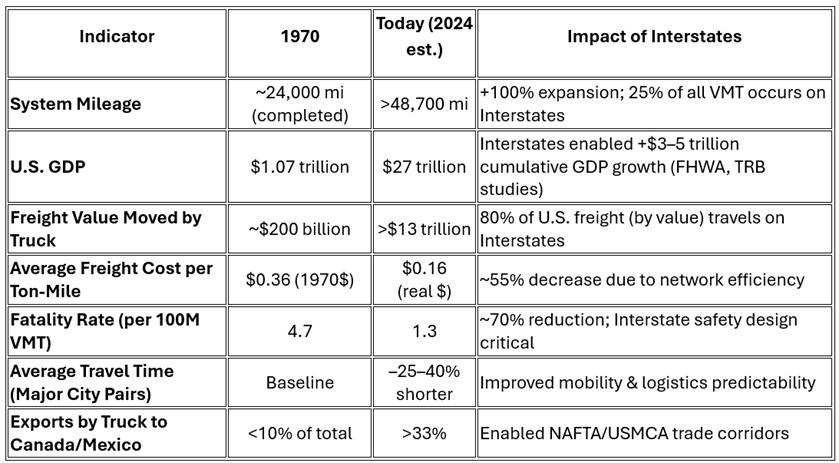
Since its inception under the Federal-Aid Highway Act of 1956, the Interstate Highway System has become the backbone of U.S. commerce, defense, and mobility. By 1970, roughly half the system was open; by 1991, 99% was complete. From 1970 onward, the interstate network transformed the American economy through lower transportation costs, expanded trade regions, and increased productivity.
Key Economic Metrics (1970–2024)
|
Regional Economic Development
- Interstates created an uneven but powerful wave of regional growth:
- Sunbelt & Great Plains expansion: Rural counties with new interstate access saw employment grow 7–10% faster over two decades.
- Manufacturing & logistics hubs: Growth of distribution centers along I-35, I-40, I-70, and I-10 corridors.
- Metropolitan decentralization: Enabled suburban growth around key interchanges and bypasses.
- Tourism & service economy: Interstate travel spurred hospitality, fuel, and retail sectors along corridors.
Economic Rate of Return
According to multiple studies (FHWA, TRB, CBO):
- Initial decades (1956–1980): ROI >35% annually — highest of any U.S. public infrastructure.
- Post-1980 modernization (rehabilitation era): ROI stabilized around 15–20%.
- Current marginal returns (2020s): 8–12% for freight corridors—still well above average public investment yields.
Rural and Freight-Specific Impacts
- Rural access: Counties connected to interstates have 19% higher per-capita income and 23% more employment in goods-producing sectors.
- Freight reliability: 47% of truck-miles occur on interstates; reliability improves supply-chain competitiveness by 20–25%.
- Defense & emergency mobility: 90% of STRAHNET mileage is interstate, ensuring national readiness and disaster response capability.
Contemporary Trends (1990–Present)
- Freight logistics: Rise of “just-in-time” delivery increased dependence on interstate reliability.
- E-commerce: Growth of fulfillment and last-mile hubs near interstate interchanges.
- Infrastructure age: Over 40% of interstate pavements and bridges are beyond their original 50-year design life.
- Reinvestment need: FHWA estimates $900 billion needed over 20 years for modernization and expansion.
Looking Forward
The Interstate System remains America’s economic circulatory system, carrying:
- 25% of all vehicle miles traveled
- 80% of freight by value
- Over $13 trillion annually in goods
Modernizing and extending this network through future interstates will deliver the next generation of economic growth, particularly in rural and trade-dependent regions.
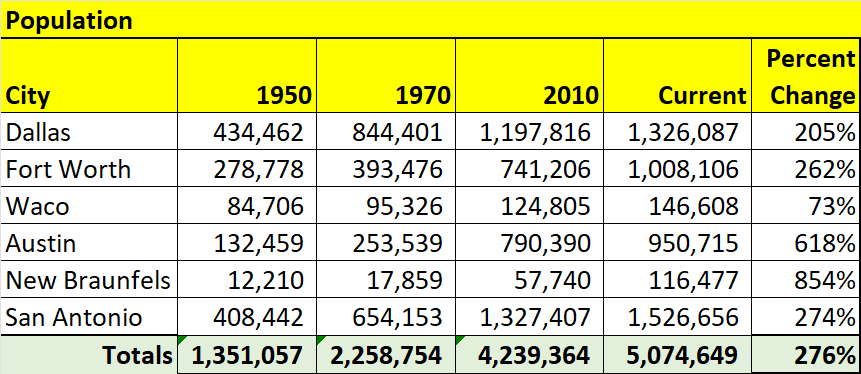
The following table provides a look at cities along Interstate 35 from before the Federal-Aid Highway Act of 1956 was passed, when half the original Interstate System was open, after the system was completed and the current. This is limited to a select set of cities and shows a significant increase of 276% with some cities showing more than 600% from 1950 to 2025.
|
Since 1970, the Interstate Highway System has multiplied U.S. productivity, reduced transport costs by half, and added trillions in economic output. Each new or upgraded interstate corridor yields sustained regional GDP growth, job creation, and trade competitiveness — proving that strategic expansion of the system remains a cornerstone of America’s economic future.
|
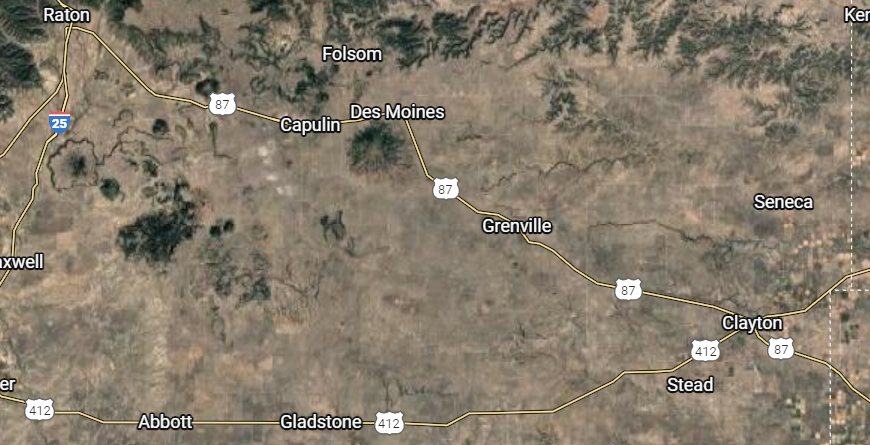
US 64/87 Ports-to-Plains Feasibility Study (NM)
|
“The New Mexico Department of Transportation is in the process of finalizing a contract with Parametrix to prepare the Phase I-A/B report for the US 87/US 64 sections of the Ports-to-Plains Corridor (Proposed I-27). The study will kick off in Spring 2026 and is expected to take 18 months to complete. The team is enthusiastic about partnering with the P2P Alliance and engaging stakeholders throughout the corridor.” -- From Parametrix
Technical Description of Project: This is a study regarding the Future Interstate Highway along the Ports-to-Plains Corridor (US 87/64) between the New Mexico-Texas state border and Raton. The Future Interstate Highway has potential to provide positive economic development impacts for northeast New Mexico.
|
What to expect from a Phase I-A/B report?
- The Phase I-A/B Report is part of NMDOT’s Location Study and Project Development process used for transportation projects (e.g., roadway improvements, interchange reconstruction, new alignment). It represents the early planning stages that identify and evaluate alternatives before formal environmental clearance (Phase I-C) and design.
- Define the Project Purpose and Need
- The report establishes:
- Why improvements are necessary
- What transportation problems need addressing (e.g., safety, capacity, operations)
- This drives all alternative evaluations.
- Identify and Evaluate Alternatives
- Phase I-A and Phase I-B together:
- Develop multiple potential solutions (build alternatives and no-build)
- Screen early concepts
- Evaluate alternatives against purpose and need
- Refine the range of alternatives being considered
- The goal is to identify which alternatives should move forward for environmental review in Phase I-C.
- Incorporate Stakeholder and Public Input
- Phase I-A/B usually includes:
- Public meetings/involvement
- Coordination with agencies and tribes
- Stakeholder engagement
- This helps identify community needs and concerns and informs alternative scoring.
- Provide a Basis for Environmental and Preliminary Design
- The report’s findings:
- Help establish the preferred alternative
- Provide data that will be used in Phase I-C (NEPA documentation)
- Support early cost estimation and design considerations
- This streamlines later environmental and design work.
Link to Completed Phase I-A/B report
|
Update on Heartland Expressway Expansion Project
|
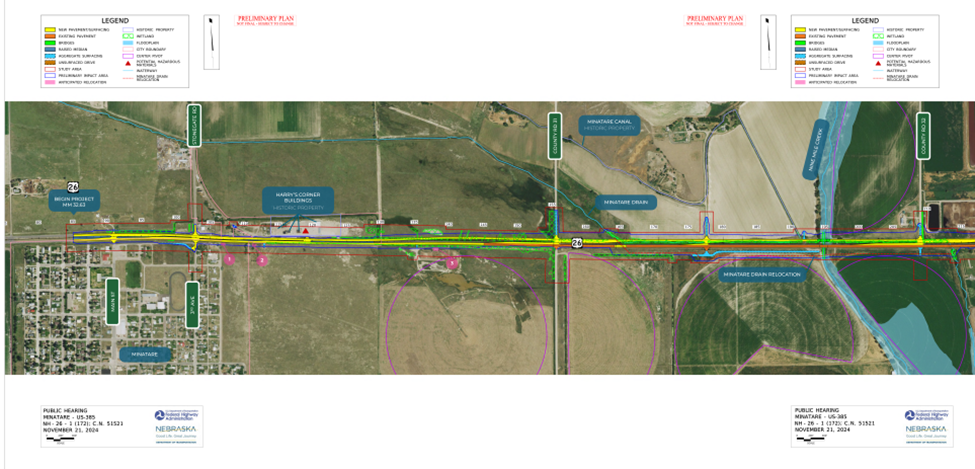
We appreciate the update on Heartland Expressway Four Lane Expansion - U.S. 26 between Minatare and U.S. 385 at Intersection L62A provided by the Nebraska Department of Transportation (NDOT).
Background
U.S. Deb Fischer (NE) submitted this as a Congressionally Designated Project in 2024 and the project was awarded NDOT $12.865 million. The Nebraska Department of Transportation (NDOT) held a public hearing regarding the preliminary design and draft Environmental Assessment (EA) on Thursday, November 21, 2024.
The Final Environmental Assessment Finding of No Significant Impact was issued by FHWA on May 9, 2025. CLICK HERE to View or Download the document.
On June 27, 2025, Dawn Knott, P.E. Project Studies Engineer, presented the project to the Nebraska State Highway Commission, who approved the project unanimously. CLICK HERE to View or Download the presentation. This presentation did a great job in summarizing the history, scope, etc. of the project.
On Friday, September 5, 2025 the projects was published in the Federal Register with a Finding of No Significant Impact. CLICK HERE to View or Download the document.
|
Update
Since the public hearing in November 2024, the general project scope was refined and divided into two construction packages. The decision was based on the construction phasing with the irrigation districts, some utility relocations, and drainage structures, among other items.
- Package A - Pre-work components
Includes grading, culverts, irrigation structures, and other preliminary construction activities. Offers for acquisition associated with Package A have been issued and negotiations are currently underway.
Construction for this phase is anticipated to begin in 2026.
- Package B - Major construction components
This package will include the remainder of the roadway improvements, including utility relocations, grading, and paving. Negotiations for Package B have not yet begun. Work associated with Package B is currently anticipated to take place in 2027-2028.
NDOT is prioritizing our efforts to those landowners affected by Package A to allow for optimum construction phasing. When the acquisition process for Package B begins, NDOT will prioritize properties with higher impacts, including those potentially eligible for relocation benefits, to ensure adequate time for planning, coordination, and support.
CLICK HERE to View or Download the document.
|
Larry Schmaltz, Belle Fourche, SD - Interstate Advantage
|
We’re a small community with a big message: United we build. Not just roads and bridges, but opportunity, connection, and national pride.
We are the northern gateway to the Black Hills and a key corridor to national treasures like Mount Rushmore, Theodore Roosevelt National Park, Yellowstone National Park, Devils Tower, and Badlands National Park. Tourism is a major economic driver in this region. But tourism doesn’t move without roads. Connectivity matters.
These aren’t just truck routes—they’re lifelines. For energy. For agriculture. For national defense. And for rural communities like ours. When we invest in connectivity, we’re not just moving products—we’re moving potential.
Through national connectivity, vibrant tourism, and a shared respect for the landscapes that define us, we are writing the next chapter of America’s story—from the Center of the Nation outward.
“Belle Fourche, SD – United We Build.”
|
Joe Kiely
Vice President of Operations
Ports-to-Plains Alliance
PO Box 758
Limon, CO 80828
Cell: (719) 740-2240
joe.kiely@portstoplains.com
|
Cal Klewin
Executive Director
Theodore Roosevelt Expressway Association
PO Box 1306
Williston, ND 58802
701-523-6171
cal@trexpressway.com
|
Deb Cottier
Chair
Heartland Expressway Association
c/o TCD
1820 Broadway
Scottsbluff, NE 69341
308-432-4023
dcottier@gpcom.net
|
|