July 2026 Volume 24 Issue 7
|
We are a voice for our small town, grassroots members who may otherwise not have access to the right audiences, as well as a conduit for industry to come together in support and promotion of transportation improvements.
We are committed to working as an Alliance to improve transportation infrastructure and business networks opportunities, by advocating for appropriate funding levels, so business and industry can thrive.
We are focused on the economic and business interests that are the lifeblood of the region.
|
Be Sure Newsletter Email is Allowed
|
As you may have noticed, the monthly Ports-to-Plains Newsletter is sent through our member database. Please be sure the email address pal@memberclicks-mail.net is allowed on your system.
|
There is this comedian whose routine includes a dialogue about competing with his siblings for the best seat in the family car. The car he describes has a hump between the seats to make room for the drive train and transmission. The joke is since he never can win the “best seat”, he always calls the “hump “which is disturbing to his parents. You may have heard someone call “shotgun” when referring to the best seat in the vehicle. That is a term that goes all the way back to the stagecoach era of transportation when travel across the wild west needed to be secured in some way from hostiles and robbers. An extra rider was assigned to the coach with a shotgun to ward off attacks and assaults upon the party. The issue of security on our transportation routes is an ancient issue. Think about it, even the “Good Samaritan” story is about a highway robbery. And you would think as we populate and civilize our wild places that the need for transportation security would diminish. But that doesn’t seem to be the case. My father-in-law used to tell us of an incident when they were travelling across the Arizona desert to California in the late 40’s and they had to use a shotgun to prevent a carjacking and robbery. Even the Tier 1 rail lines still describe the problem of theft and vandalism on their rail system today. So, when we talk about building a secure transportation corridor, you begin to understand this context of security and the need for it.
|
But there is another way that we look at security from the context of trade. When you hear our oil and gas industry talk about not being dependent on foreign oil in unstable regions of the world, they define energy security as domestic energy resources that we have more control over. This could include our trading relationship with Mexico and Canada. When we describe the need to obtain food security, again we are talking about controlling those supply chains within the Mexico-United States-Canada regions by reducing the influence of external forces upon our agricultural markets.
So how does building a modern interstate corridor through the mid-western United States help us achieve energy and food security while at the same time provide a safer environment for driving public and carriers of our freight commodities? Let me describe a few ways. First, accompanying a new interstate corridor will be significant levels of economic development. New business opportunities spring up and with that population shifts will occur to support those new economies. This concentrated growth along new interstate routes will aid in creating a safer and more secure corridor. Second, a modern interstate highway will be incorporating all of the new technologies both currently available and those not yet created that will help in securing freight and pedestrian travel. This is in addition to the existing security and safety features that an interstate highway brings to the traveling public. Things like controlled access, safety lighting, and modernized truck parking are just a few features that this intestate highway will bring to you. Providing easier and faster access to our key energy and agricultural resources aids in accomplishing that goal of energy and food security. Finally, having a significant length of interstate highway along our border will create a 400-foot-wide zone that can be secured in ways that will support our nation’s Defense and Homeland Security missions. Now we can understand the importance of having security in our national highway system and the role that interstates play in providing that security.
I am looking forward to seeing you at our Annual Conference hosted by Acuña, Coahuila and Del Rio, Texas.
more to come …
Lauren D. Garduño
|
Ready of Not, It's 2026 Conference Time
|
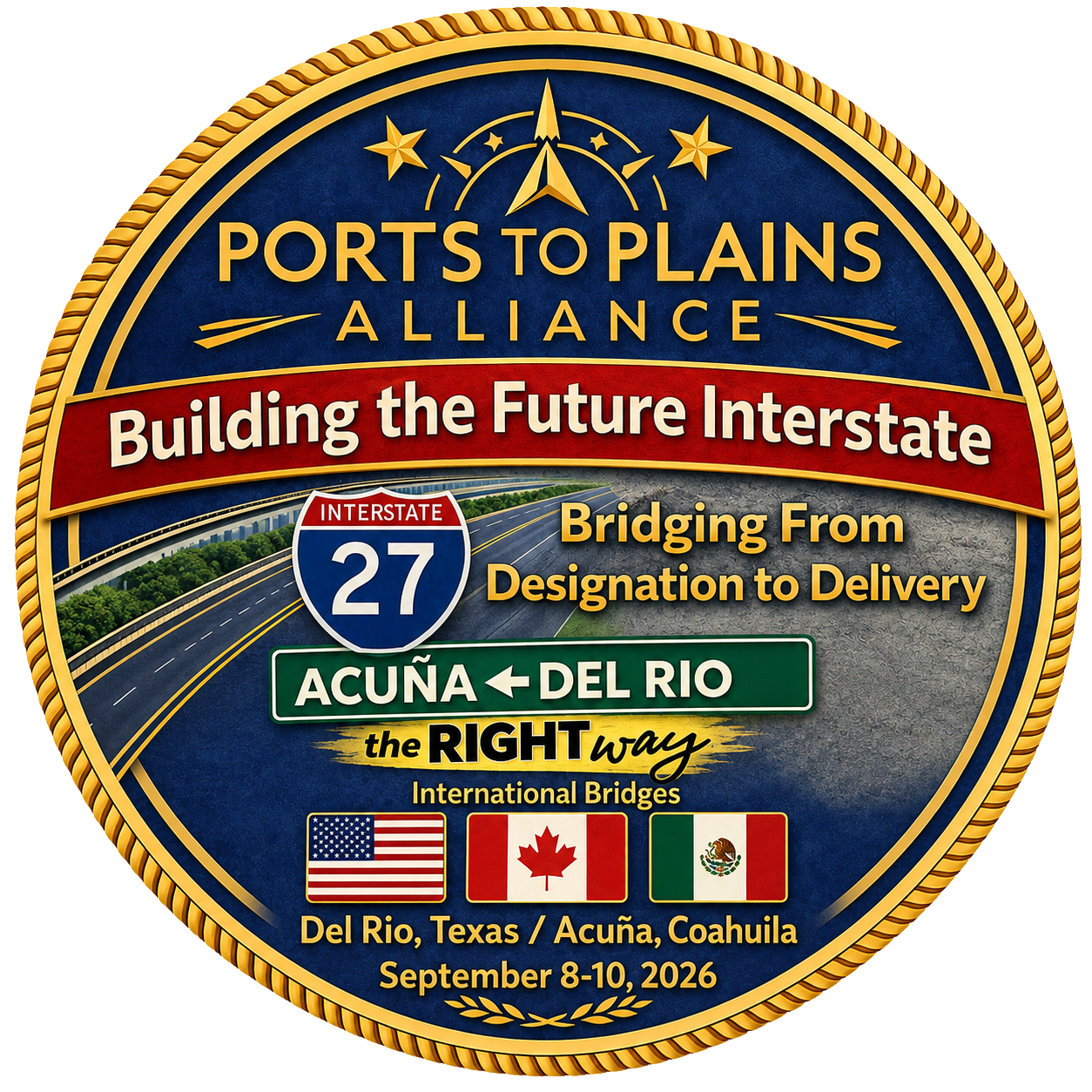
2026 Ports-to-Plains Alliance Conference
DelRio, Texas / Acuna, Coauoila September 8-10, 2026
|
This will be the largest Ports-to-Plains Conference in history. We have 284 registered. See you all on September 8th.
Thanks to our sponsors!
|
Partnership Study Measures the Full Economic Value of Corridor Investment
|
The Ports-to-Plains Alliance is partnering with Regional Economic Models, Inc. (REMI) and North Dakota State University’s Upper Great Plains Transportation Institute (UGPTI) to complete a comprehensive study of the Economic Impact of Corridor Investment & Long-Run Transportation Efficiency for each of the nine Ports-to-Plains Alliance states.
The analysis will measure both the immediate economic activity generated by constructing the corridor and the lasting benefits created after the improvements are completed.
The study evaluates two major phases:
Construction phase: Measures the direct, indirect, and induced effects of corridor investment, including job-years, economic output, gross domestic product, and tax revenue.
Operations phase: Measures the long-term economic benefits of improved transportation efficiency, including lower travel costs, more reliable freight movement, improved market access, business growth, employment, population, and state and local tax revenue. The analysis is being completed for the states served by the Ports-to-Plains Corridor, Heartland Expressway, and Theodore Roosevelt Expressway. State-level reports will show how corridor investment affects each state individually, while the broader study will demonstrate the corridor’s combined regional and national significance.
REMI’s economic modeling traces how transportation investment moves through industries, suppliers, workers, and households over time. Its TranSight platform connects transportation improvements to longer-term changes in jobs, income, population, and economic competitiveness. Learn more about REMI transportation modeling. UGPTI contributes specialized transportation research and corridor analysis, helping connect the physical improvements to changes in mobility, freight efficiency, accessibility, and economic competitiveness.
Together, the partners are developing a more complete picture of the corridor’s value—looking beyond construction spending to measure how a completed Interstate-quality corridor would strengthen communities and state economies for decades.
The findings will provide the Alliance and its partners with credible data to support federal transportation reauthorization, Future Interstate designation, state investment decisions, corridor planning, and the proposed Multi-State Future Interstate Highway Formula Program.
|
Nebraska Report Demonstrates the Long-Term Value of Corridor Investment
|
A new economic analysis prepared for the Ports-to-Plains Alliance by Regional Economic Models, Inc. (REMI) and North Dakota State University’s Upper Great Plains Transportation Institute (UGPTI) demonstrates that upgrading Nebraska’s portion of the corridor to interstate standards would generate significant construction activity while creating lasting economic benefits through improved transportation efficiency. The Nebraska corridor covers an estimated 221 miles. For planning purposes, upgrading it to Interstate standards over a 25-year period is estimated to require approximately $3.381 billion, an average of $10.45 million per mile in 2026 dollars or $15.3 million per mile when construction costs are inflated at 3% annually over the 25-year period. The estimate assumes frontage roads would be needed along approximately 20% of the corridor. Actual costs will vary by segment depending on existing highway configuration, bridges, interchanges, right-of-way, utilities, environmental requirements, and urban conditions.
The construction phase is projected to support approximately 77,393 job-years and generate $15.46 billion in total statewide economic output. This includes the direct effects of construction, purchases from Nebraska suppliers and businesses, and household spending supported by construction-related wages.
Every direct construction job-year is projected to generate an additional 0.78 job-years elsewhere in Nebraska’s economy. Similarly, every dollar of direct construction output would generate another $0.81 in indirect and induced economic activity. The construction phase is also projected to produce approximately $8.53 billion in gross domestic product, $5.75 billion in personal income, and nearly $679.9 million in total tax revenue.
The benefits do not end when construction is completed. Improved travel times, reliability, accessibility, and freight efficiency would continue strengthening Nebraska’s economy for decades. Compared with the baseline forecast (existing conditions) , the completed corridor is projected to support 2,087 sustained jobs in 2050, increasing to 3,281 jobs by 2070.
By 2070, the transportation-efficiency benefits are also projected to: - Add approximately 6,136 Nebraska residents.
- Increase annual economic output by nearly $1.6 billion.
- Generate approximately $55.9 million in annual tax revenue.
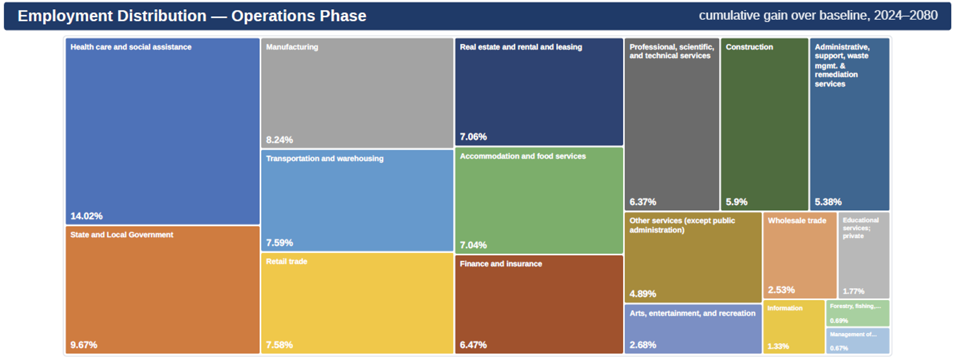
The employment gains would extend across Nebraska’s economy, led by health care, state and local government, manufacturing, retail trade, transportation and warehousing, real estate, construction, professional services, finance, hospitality, and other industries.
|
The findings show that the corridor is more than a highway construction project. It is a long-term economic development investment that can improve Nebraska’s access to markets, lower business transportation costs, expand the workforce, strengthen rural communities, and connect the state more effectively with national and international trade networks.
|
Theodore Roosevelt Expressway: Construction Progress and the Next Priority Nearly 18 Miles of Four-Lane Highway Under Construction
|
The Theodore Roosevelt Expressway along U.S. Highway 85 is making significant progress toward becoming a continuous four-lane north-south transportation corridor through western North Dakota. Construction underway between the Long X Bridge and North Dakota Highway 200 represents one of the project’s most significant advances to date.
Two major contracts totaling approximately $145.5 million will add more than 18 miles of four-lane divided highway: - ND Highway 200 to Reference Point 120.3: A 12.85-mile project awarded to Strata Corporation for approximately $61.7 million.
- Reference Point 120.3 to the Long X Bridge: A 5.5-mile project awarded to Park Construction Company for approximately $83.8 million.
Construction began in spring 2026. The Strata project is scheduled for completion in 2027, while the more challenging segment through the Little Missouri Breaks will require multiple construction seasons. Together, these projects continue the southward expansion of four-lane U.S. 85 from the Watford City area and advance the long-term vision for the Theodore Roosevelt Expressway. View the current construction update.
The Remaining Critical Connection
As construction advances toward Highway 200, the next logical and strategic priority is the approximately 31-mile section extending south from Highway 200 to Interstate 94.
Completing this section would connect the Theodore Roosevelt Expressway directly to the Interstate Highway System and create a continuous four-lane route through western North Dakota—from the northwestern portion of the state to I-94. This connection is especially important for: - Energy and agriculture: Providing a safer and more efficient route for heavy trucks serving energy production, agriculture, and regional commerce.
- Freight movement: Strengthening a major north-south trade corridor connecting Canada and western North Dakota with Interstate and national markets.
- Economic development: Improving access for communities, businesses, industrial development, workforce movement, and future private investment.
- Tourism: Expanding access to Theodore Roosevelt National Park, the North Dakota Badlands, and other western North Dakota destinations.
- Safety: Replacing additional sections of two-lane highway with a modern, divided four-lane facility.
- National connectivity: Advancing the Theodore Roosevelt Expressway as part of the larger Ports-to-Plains Alliance Corridor connecting Mexico, the United States, and Canada.
NDDOT has advanced engineering design on portions of the remaining corridor, but right-of-way acquisition, utility relocation, and construction depend on securing additional state or federal funding. Review NDDOT’s U.S. 85 expansion program.
A Strategic Opportunity for 2027
The current construction activity creates an important opportunity to advance the next phase. Positioning the Highway 200-to-I-94 section for bidding beginning in 2027 could build upon the momentum already underway in western North Dakota.
Contractors working in the region may be able to achieve efficiencies in equipment movement, workforce mobilization, staging, material production, and subcontractor relationships. These conditions could encourage bidder participation and help North Dakota receive greater value from its continued investment in U.S. 85.
Maintaining Momentum
The top priority should be to position the approximately 31 miles between ND Highway 200 and I-94 for construction as soon as practical, with a goal of beginning the bidding process in 2027.
North Dakota has already made a substantial investment in extending four-lane U.S. 85 southward. The current construction between the Long X Bridge and Highway 200 has created momentum that should not be lost.
Completing the connection to I-94 would transform the Theodore Roosevelt Expressway from a series of improved segments into a continuous four-lane corridor—strengthening safety, freight mobility, economic development, tourism, and western North Dakota’s long-term competitiveness.
|
Heartland Expressway Construction Advances as Advocates Look Toward Future Interstate
|
The Heartland Expressway is gaining significant momentum in western Nebraska, with nearly $100 million in construction underway and corridor advocates continuing to pursue its long-term development as a Future Interstate. Members and supporters gathered in Gering on August 19 for the Heartland Expressway Association’s 2026 Annual Meeting. The program highlighted construction progress, funding priorities, and the importance of completing the corridor as a safe, efficient, multilane connection serving Nebraska and the Great Plains.
Nearly $100 Million in Construction Underway
The most visible progress is the Minatare-to-U.S. 385 project, an approximately 18.5-mile improvement along U.S. 26 and Link 62A. The nearly $95 million project will rehabilitate the existing highway and construct two additional lanes, creating a four-lane divided expressway between Minatare and the U.S. 385 junction. Construction began in June 2026. The project includes grading, pavement construction, bridge and culvert work, intersection improvements, and other upgrades necessary to improve safety and capacity. It represents one of Nebraska’s largest recent investments in the Heartland Expressway and closes another important gap between Scottsbluff and Alliance. View the Nebraska Department of Transportation project information.
Garduño Outlines Federal Strategy
During the annual meeting, Ports-to-Plains Alliance President and CEO Lauren Garduño presented an update on the corridor’s federal funding progress and the Alliance’s strategy for advancing the Heartland Expressway through the next surface transportation reauthorization bill.
Garduño explained that completing the corridor will require more than individual projects funded one segment at a time. A coordinated federal approach is needed to plan, designate, fund, and construct multistate Future Interstate corridors that cross several state boundaries but serve a unified national purpose. He highlighted three federal priorities: - Future Interstate designation and route numbering for the Heartland Expressway, Theodore Roosevelt Expressway, and the remaining Ports-to-Plains Corridor;
- A Multistate Future Interstate Feasibility Study to provide consistent economic, engineering, safety, and mobility information across the corridor; and
- A dedicated Multi-State Future Interstate Highway Formula Program to provide predictable funding for planning, design, right-of-way acquisition, and construction.
The presentation emphasized that formula funding would allow states to coordinate long-term corridor delivery instead of relying primarily on uncertain, project-by-project competitive grants.
Connecting Nebraska to National and International Markets
The Heartland Expressway is a federally designated High Priority Corridor extending through Colorado, Nebraska, Wyoming, and South Dakota. It forms the central portion of the broader Ports-to-Plains Alliance Corridor, connecting the Ports-to-Plains Corridor to the south with the Theodore Roosevelt Expressway to the north.
When completed, the Heartland Expressway will provide a more seamless north-south route connecting rural communities, agricultural and energy-producing regions, regional trade centers, and major east-west Interstates. The improvements will strengthen freight mobility, reduce travel times, improve highway safety, support tourism, and make western Nebraska more competitive for business development and private investment.
The construction now underway demonstrates that the Heartland Expressway is moving from planning to visible progress. Maintaining that momentum will require continued collaboration among local communities, the Nebraska Department of Transportation, state leaders, Congress, and corridor partners.
|
Joe Kiely
Vice President of Operations
Ports-to-Plains Alliance
PO Box 758
Limon, CO 80828
Cell: (719) 740-2240
joe.kiely@portstoplains.com
|
Cal Klewin
Executive Director
Theodore Roosevelt Expressway Association
PO Box 1306
Williston, ND 58802
701-523-6171
cal@trexpressway.com
|
Deb Cottier
Chair
Heartland Expressway Association
c/o TCD
1820 Broadway
Scottsbluff, NE 69341
308-430-5959
dcottier@gpcom.net
|
|