Wyoming Implementation
Wyoming: Connections
Wyoming plays an important role in advancing the Heartland Expressway and strengthening the broader Ports-to-Plains Alliance network by providing a strategic connection to Interstate 25 that helps distribute north–south traffic more efficiently while offering an alternative connection to I-25 that avoids adding pressure to the heavily traveled I-80/I-25/U.S. 85 interchange in Cheyenne. Today, U.S. 26 from the Nebraska state line to Interstate 25 at Dwyer Junction remains primarily a two-lane highway, with a four-lane divided segment through Torrington, serving as an important but incomplete link in this regional corridor. Through the U.S. 26 corridor between Nebraska and I-25 at Dwyer Junction, Wyoming supports improved freight mobility, tourism, agriculture, energy development, and military readiness while creating a safer and more reliable route across eastern Wyoming. Continued investment in this corridor helps complete a critical missing link in the regional transportation network, improves rural connectivity, supports economic growth, and strengthens long-term Future Interstate development across the Great Plains.akota, North Dakota, Montana, Wyoming, and the broader Great Plains freight network, while supporting tourism, agriculture, energy, construction, defense access, and rural economic development.
Corridor Successes
Wyoming’s key success has been maintaining its place in the long-term Heartland Expressway vision as part of a federally recognized High Priority Corridor connecting the Great Plains to Interstate 25. While significant capital investment on U.S. 26 in Wyoming has not yet occurred, the corridor remains strategically important because it preserves a direct alternative connection to I-25 north of Cheyenne, helping avoid additional traffic pressure at the heavily traveled I-80/I-25/U.S. 85 interchange. Wyoming’s continued participation in regional corridor planning with Nebraska, South Dakota, and Colorado has helped keep this route in federal and multi-state transportation discussions, protecting the opportunity for future development as freight, energy, agricultural, and defense transportation needs grow.
What Is Coming?
Wyoming Congresswoman Harriet Hageman delivered remarks to the Ports-to-Plains Alliance annual conference highlighting the critical connection between transportation infrastructure, energy production, trade, and economic development across America’s heartland. Speaking from the perspective of Wyoming as a leading energy-producing state, she emphasized that economic opportunity depends on a transportation system that can efficiently move goods and people across state and international borders through reliable roads, bridges, connectors, ports, intermodal links, and border crossings. She pointed to the 2,300-mile Ports-to-Plains Corridor as a strong example of how national prosperity is tied to highway system connectivity and the movement of commerce from Mexico to Canada.
Her message focused on what is needed next: giving states greater flexibility, reducing federal delays, improving coordination, and advancing infrastructure policies that strengthen trade, economic growth, and long-term corridor development.
Key Wyoming
State Funding
Wyoming’s transportation funding system is heavily dependent on federal highway formula funds, state fuel taxes, vehicle registration fees, and mineral-related revenues, with the Wyoming Department of Transportation (WYDOT) using these resources to maintain one of the nation’s largest highway systems relative to population. WYDOT’s 2026–2031 State Transportation Improvement Program (STIP) outlines highway, bridge, transit, airport, and communications projects across the state, but the agency continues to prioritize preservation and maintenance because available funding is insufficient to address all long-term needs.
Economic Benefits
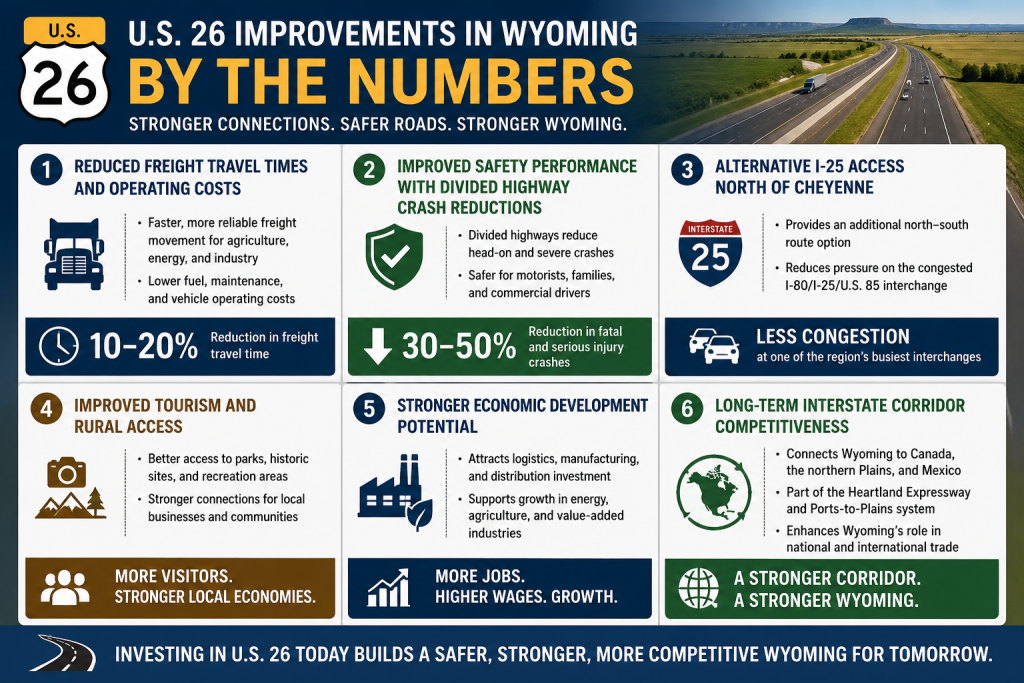
Upgrading U.S. 26 in eastern Wyoming to a ,four-lane divided highway with long-term Future Interstate standards could create significant economic benefits for Wyoming by strengthening freight mobility, improving safety, and creating a more efficient alternative connection to Interstate 25 north of Cheyenne that avoids adding congestion to the heavily traveled I-80/I-25/U.S. 85 interchange. The corridor would improve regional connectivity between Wyoming, Nebraska, South Dakota, Colorado, and the northern Plains while providing a more reliable route for agriculture, energy, mining, tourism, and manufactured goods moving through eastern Wyoming.
A four-lane divided facility would likely improve travel reliability and freight efficiency, reducing delays caused by slow-moving trucks, passing conflicts, weather-related closures, and safety incidents common on rural two-lane highways. Lower travel times and improved reliability can reduce trucking costs, improve supply chain performance, and make Wyoming producers more competitive in domestic and international markets. For energy and agriculture sectors—two of Wyoming’s economic drivers—improved highway capacity can enhance movement of oilfield equipment, livestock, grain, fertilizer, construction materials, and oversized loads that depend on dependable rural freight routes.
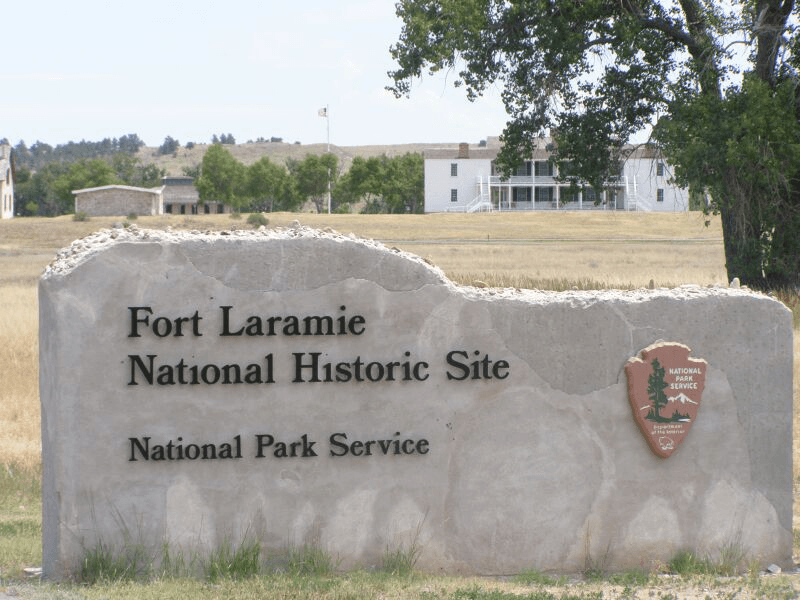
Safety improvements alone could generate measurable economic value by reducing crashes, injuries, fatalities, emergency response costs, insurance losses, and freight disruptions. Four-lane divided highways consistently provide safer operations than rural two-lane facilities by reducing head-on collisions, dangerous passing movements, and traffic conflicts. In addition, stronger corridor connectivity can support tourism and rural economic development, improving access to destinations such as Fort Laramie, Guernsey State Park, recreation areas, and local communities while making eastern Wyoming more attractive for industrial investment and logistics-related business activity.
If developed to Future Interstate standards, U.S. 26 could also create long-term strategic economic benefits by becoming part of a larger north-south freight corridor connecting Canada, the northern Plains, and Mexico through the Heartland Expressway and Ports-to-Plains system. Interstate designation typically increases market access, site-selection competitiveness, freight efficiency, and long-term private sector confidence, helping communities along the route compete for distribution, manufacturing, energy, agricultural processing, and logistics investment. For Wyoming, this would not simply be a highway improvement—it would be a long-term investment in economic competitiveness, freight resilience, and statewide connectivity.
Support in the Wyoming Legislature
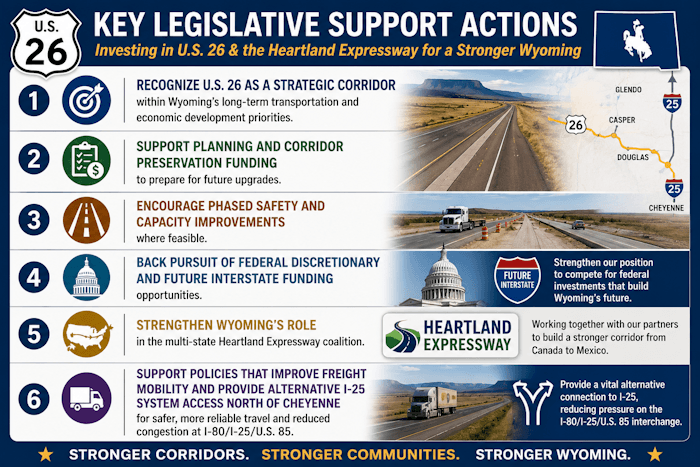
Wyoming legislative support will be essential to preserve long-term opportunities for U.S. 26 and the Heartland Expressway as a strategic transportation corridor connecting eastern Wyoming to Interstate 25 and the broader Heartland Expressway network. With WYDOT focused heavily on preservation needs and Interstate 80 funding demands, legislative leadership is needed to ensure U.S. 26 remains part of Wyoming’s long-range transportation vision through planning, corridor preservation, phased safety improvements, and pursuit of future state and federal funding opportunities. Supporting this corridor can improve freight mobility for agriculture, energy, and industry, enhance safety, strengthen rural economic development, and provide a valuable alternative connection to I-25 north of Cheyenne that reduces pressure on the heavily traveled I-80/I-25/U.S. 85 interchange, positioning Wyoming for long-term economic competitiveness and future interstate development.