
Montana Implementation
Montana: Connecting to Canada
Montana provides the Theodore Roosevelt Expressway’s critical connection to Canada through U.S. 2, Montana Highway 16, and the Port of Raymond. This northern gateway links eastern Montana and the broader Ports-to-Plains corridor to Canadian trade routes, strengthening access for agriculture, energy, manufacturing, tourism, and cross-border commerce. Continued investment in this corridor improves freight reliability, border access, rural connectivity, and long-term economic opportunity while helping complete a modern north–south trade route from Mexico to Canada.
Corridor Successes
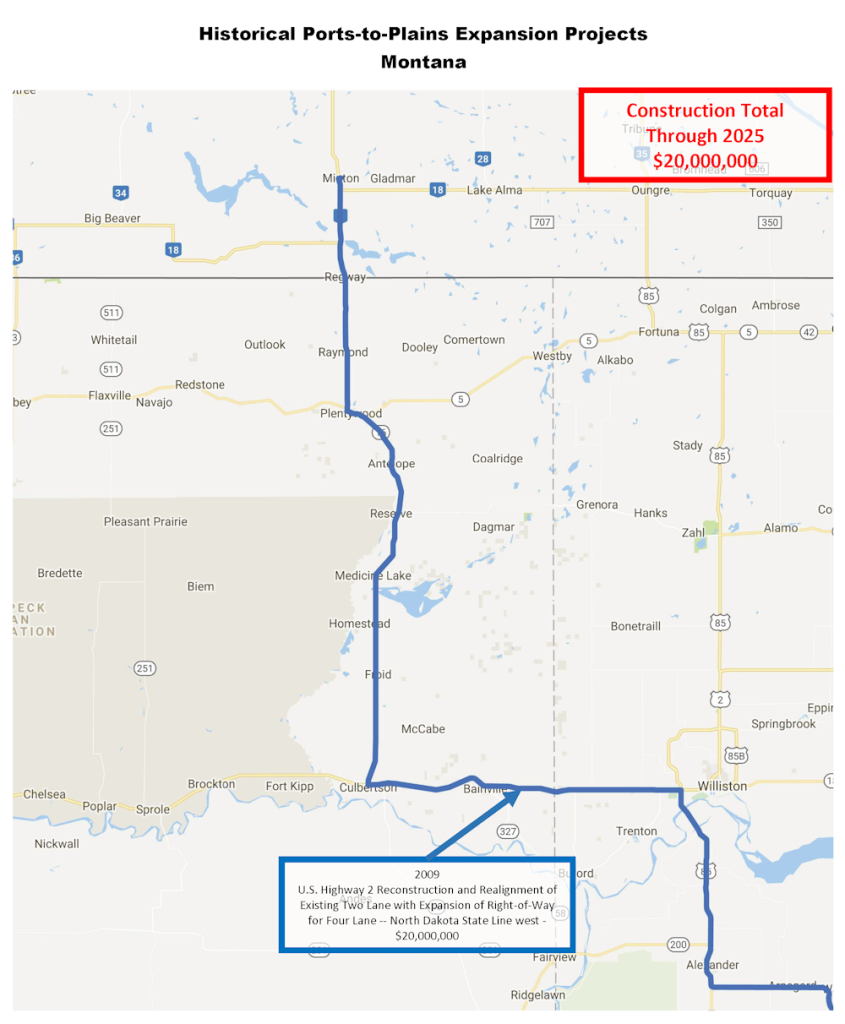
Montana has already made important progress advancing the Theodore Roosevelt Expressway through eastern Montana. Through 2025, the state has completed approximately $20 million in corridor construction investment. This includes the 2009 U.S. Highway 2 reconstruction and realignment project west of the North Dakota state line, which improved the existing two-lane highway while expanding right-of-way for future four-lane development. This early investment helped establish the foundation for continued corridor improvements, safer travel, stronger freight movement, and long-term connectivity between Montana, North Dakota, and Canada.
What Is Coming?
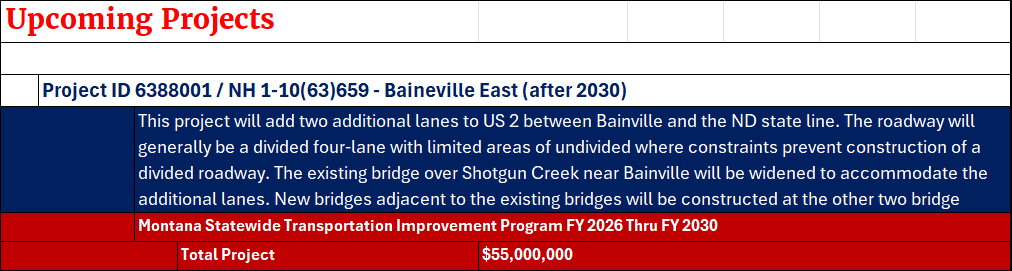
The 2026–2030 Draft STIP lists Bainville – East as a Glendive District regionally significant reconstruction project with an estimated construction cost of $55 million and letting date >2030.
Key Montana
State Funding
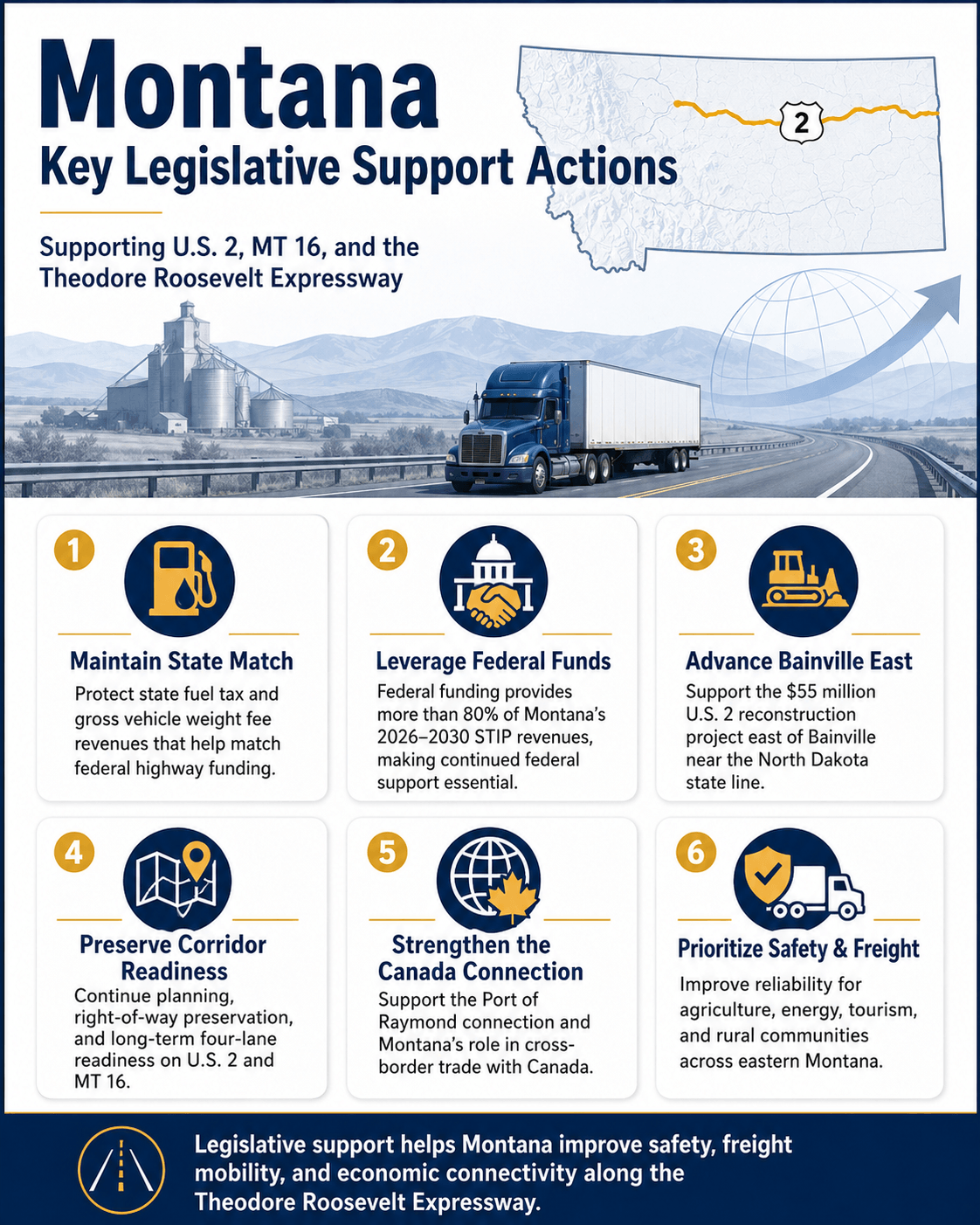
Montana’s transportation program depends on a strong partnership between state and federal funding. According to MDT’s 2026–2030 Draft STIP, the majority of Montana’s non-federal highway match comes from the state’s 33-cent-per-gallon fuel tax and gross vehicle weight fees. These state resources are essential because they allow Montana to match and leverage federal highway dollars for planning, right-of-way, bridge, safety, reconstruction, preservation, and freight-related improvements.
Federal funding is especially important in Montana because the state has a large highway system, long travel distances, rural freight routes, border connections, and transportation needs that exceed available revenues. MDT notes that transportation needs outpace revenues by a 3-to-1 ratio, making federal participation critical to maintaining system performance and advancing major corridor improvements. For fiscal years 2026–2030, MDT identifies approximately $3.416 billion in estimated federal apportionments and approximately $452.3 million in state match supporting the highway program. Federal funding provides more than 80% of Montana’s total 2026–2030 STIP revenues and nearly 88% of the combined federal/state highway match structure, making continued federal participation essential to advancing major corridor improvements such as the Theodore Roosevelt Expressway.
For the Theodore Roosevelt Expressway, federal funding is critical because projects such as U.S. 2, MT 16, and the Port of Raymond connection serve more than local traffic. They support interstate commerce, agricultural and energy freight, rural safety, access to Canada, and the broader Ports-to-Plains corridor vision. Continued state investment gives Montana the ability to compete for and match federal funds, while sustained federal support helps make large-scale reconstruction and future four-lane corridor readiness financially achievable.
The STIP also identifies Montana’s Highway State Special Revenue Account as the source for the State Funded Construction Program, which supports projects that preserve highway conditions and extend the service life of state highways. MDT estimates $75 million in state-funded construction expenditures for fiscal years 2026–2030. Together, state and federal funding provide the foundation for Montana to continue improving U.S. 2, advancing Bainville East, strengthening MT 16, and maintaining the state’s connection to the national and international freight network.
Economic Benefits
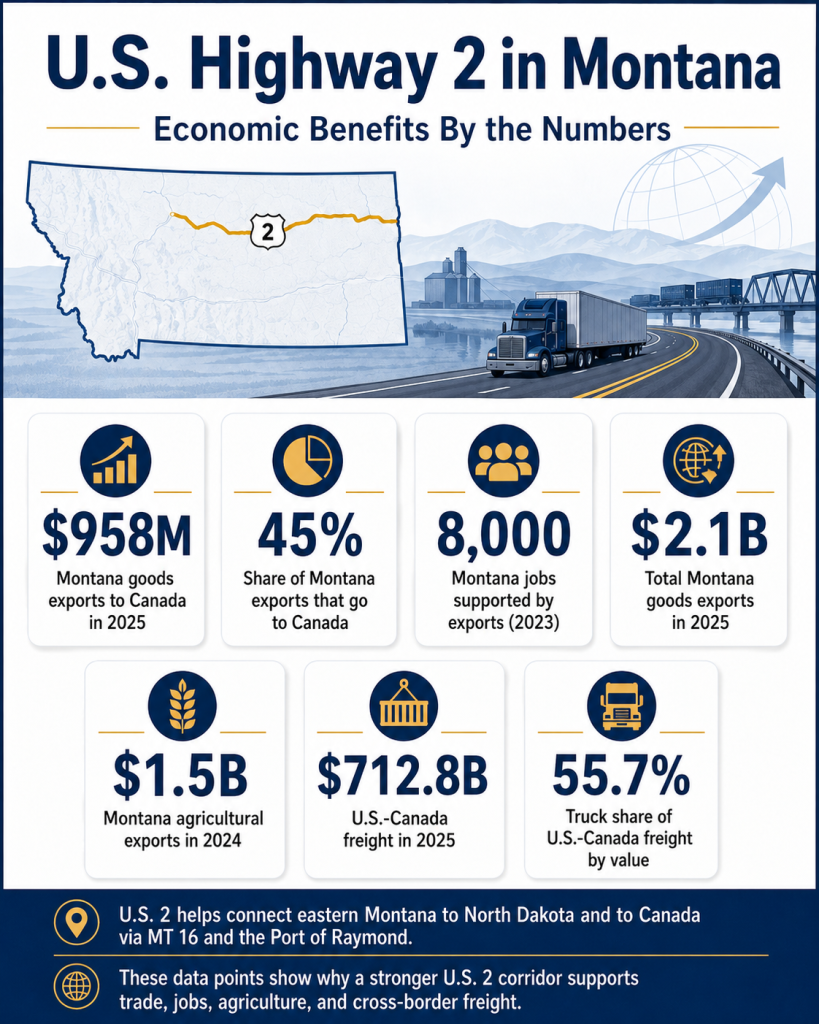
Investment in the Theodore Roosevelt Expressway strengthens Montana’s connection to one of the most important trade relationships in North America. Canada is Montana’s largest export market, with Montana exporting approximately $958 million in goods to Canada in 2025, representing 45% of the state’s total goods exports. Statewide, Montana exported $2.1 billion in goods in 2025, while exports supported an estimated 8,000 Montana jobs in 2023.
This corridor directly supports the industries that drive Montana’s export economy. Montana shipped $1.5 billion in agricultural exports in 2024, including $597 million in wheat, $195 million in beef and veal, and nearly $100 million each in processed vegetables and processed grain products. These industries depend on safe, reliable highway access to reach processors, rail connections, domestic markets, and international trade partners.
The Theodore Roosevelt Expressway also connects Montana to a much larger North American freight system. In 2025, U.S. freight with Canada and Mexico totaled approximately $1.6 trillion, including $712.8 billion in freight with Canada. Surface transportation remains the backbone of this trade, with trucks carrying 55.7% of U.S.–Canada freight by value. Improving U.S. 2, MT 16, and the Port of Raymond connection helps Montana participate more effectively in this high-value cross-border freight network.
Montana has already invested in the corridor, including $20 million for the 2009 U.S. Highway 2 reconstruction and right-of-way expansion west of the North Dakota state line. The next major step is the Bainville East reconstruction project, identified by MDT as a regionally significant U.S. 2 project with an estimated construction cost of $55 million. These investments improve safety, freight reliability, rural access, and long-term four-lane corridor readiness between Montana, North Dakota, and Canada.
For eastern Montana communities, the economic benefit is practical: better highways reduce travel delays, improve access for agriculture and energy producers, support tourism and small businesses, and strengthen connections to regional and international markets. Continued investment in the Theodore Roosevelt Expressway positions Montana as the northern gateway of the Ports-to-Plains corridor and supports long-term economic growth across the region.

Support in the Montana Legislature
Now is the time to move the Theodore Roosevelt Expressway forward in Montana. State legislative support is essential to continue progress on U.S. 2, MT 16, and the Port of Raymond connection, which together provide Montana’s link to Canada and the northern end of the Ports-to-Plains corridor.
Montana has already invested in corridor improvements, including the 2009 U.S. Highway 2 reconstruction and right-of-way expansion west of the North Dakota state line. The next major step is the Bainville East project, identified by MDT as a regionally significant reconstruction project on U.S. 2 near the North Dakota state line. Continued legislative support can help ensure that planning, right-of-way preservation, safety improvements, reconstruction, and future four-lane readiness remain priorities.
By supporting continued investment in the Theodore Roosevelt Expressway, Montana legislators can strengthen freight mobility, improve rural safety, expand access to Canadian trade routes, and help complete a nationally significant north–south corridor connecting Mexico, the United States, and Canada.