
Colorado Implementation
Colorado: Connecting the Nation
Colorado provides critical transportation connections linking the Southern Plains, Front Range, Midwest, and Northern Plains through the broader Ports-to-Plains Alliance network. The state serves as the geographic bridge between Texas, Oklahoma, and New Mexico to the south and Nebraska, Wyoming, South Dakota, North Dakota, and Montana to the north.
Key corridor connections include: U.S. 287 connecting Texas, Oklahoma, and Colorado; SH 71 / Heartland Expressway connecting Colorado to Nebraska and the broader Heartland Expressway system, Connections to I-25, I-70, and I-76 providing access to Denver, Front Range markets, and national freight routes; and Regional links to agricultural producers, energy development areas, military installations, inland ports, and international trade gateways.
These connections strengthen freight efficiency, improve supply chain reliability, support rural economies, and create alternate north–south routes that reduce congestion on heavily traveled Interstate corridors. Colorado’s position within the network allows the state to serve as a major distribution and logistics hub for the central United States while supporting future interstate expansion and long-term economic growth across the Great Plains region.
Corridor Successes
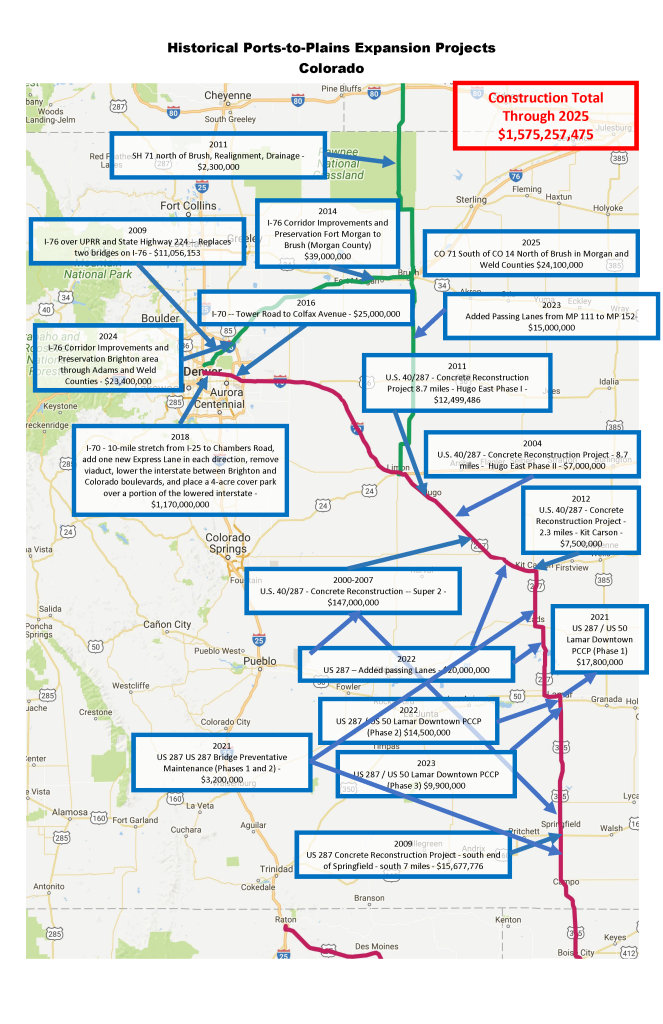
Colorado has continued making significant investments in the Ports-to-Plains Corridor and Heartland Expressway system through a series of major roadway reconstruction, bridge preservation, freight mobility, and corridor safety projects across eastern Colorado. In 2021, CDOT completed the US 287 / US 50 Lamar Downtown PCCP – Phase 1 Project, reconstructing key sections of downtown Lamar from Hickory Street to Beech Street near the Amtrak Station area using long-life concrete pavement designed to support heavy truck traffic along the Ports-to-Plains Corridor. Improvements included pavement reconstruction, drainage upgrades, intersection improvements, ADA accessibility enhancements, and long-term corridor preservation measures that strengthened freight reliability and regional connectivity across southeastern Colorado. Also completed in 2021, the $3.2 million US 287 Bridge Preventative Maintenance – Phases 1 and 2 Project improved multiple bridge structures along US 287 in Kiowa and Baca Counties near Eads, Wiley, Springfield, and Lamar through structural preservation work, bridge deck repairs, guardrail improvements, drainage repairs, and surface rehabilitation designed to extend bridge life and improve safety along this important freight corridor.
In 2022, CDOT completed the $14.5 million US 287 Lamar Downtown PCCP – Phase 2 Project extending north from Savage Avenue through downtown Lamar. The project continued reconstruction of one of southeastern Colorado’s most important freight corridors using durable concrete pavement designed for heavy truck traffic along the Ports-to-Plains Corridor. Improvements included roadway reconstruction, drainage enhancements, intersection upgrades, ADA accessibility improvements, and long-term freight corridor preservation measures supporting economic connectivity and regional commerce.
In 2023, CDOT completed the $9.9 million US 287 Lamar Downtown PCCP – Phase 3 Project from Park Street to Savage Avenue, completing another major segment of the long-term downtown Lamar reconstruction program. The project reconstructed additional roadway sections using durable concrete pavement while improving drainage, accessibility, safety, and long-term freight reliability along this critical agricultural and interstate commerce corridor. Also completed in 2023, the $15 million CO 71 Passing Lane Construction Project added multiple passing lane segments between Limon and Brush from MP 111 to MP 152 along Colorado’s portion of the Heartland Expressway. Improvements included pavement widening, roadway reconstruction, shoulder improvements, striping, signage, drainage work, and rural safety enhancements designed to improve freight mobility and reduce passing conflicts along this important north–south transportation route.
In 2024, CDOT completed the $23.4 million I-76 Corridor Improvements and Preservation Project through the Brighton area in Adams and Weld Counties. The project improved interstate pavement conditions, bridge structures, drainage systems, shoulders, and roadway safety features along one of northeastern Colorado’s most important freight corridors connecting the Denver metropolitan area with Nebraska and Midwest freight markets.
Most recently, in 2025, CDOT completed the $24.1 million CO 71 South of CO 14 Safety and Overlay Project north of Brush in Morgan and Weld Counties. The project included concrete pavement overlay, shoulder improvements, drainage upgrades, rumble strips, solar-powered warning beacons, and roadway safety enhancements designed to improve freight mobility, reduce long-term maintenance needs, and strengthen corridor reliability along Colorado’s Heartland Expressway corridor.
What Is Coming?
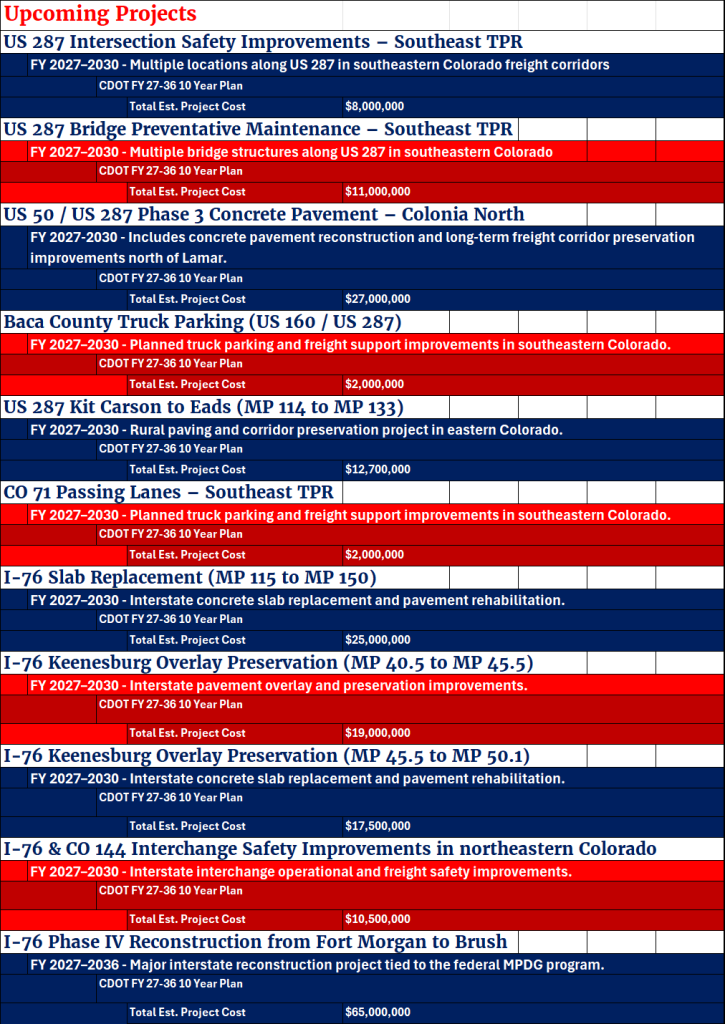
Colorado’s transportation investment momentum continues with a series of significant projects programmed in CDOT’s Statewide Transportation Improvement Program (STIP) that will strengthen the Ports-to-Plains Corridor, Heartland Expressway, I-70, and I-76 over the coming years. Along US 287, CDOT plans to invest approximately $8 million in intersection safety improvements at multiple locations across southeastern Colorado, $11 million in bridge preventative maintenance projects, and $27 million in concrete pavement reconstruction north of Lamar near Colonia. Additional investments include a $2 million truck parking facility in Baca County and a $12.7 million pavement preservation project between Kit Carson and Eads, improving safety, freight mobility, and long-term corridor reliability along Colorado’s portion of the Ports-to-Plains Corridor.
Interstate improvements are also planned throughout eastern and northeastern Colorado. Along I-76, CDOT has programmed a $65 million Phase IV reconstruction project between Fort Morgan and Brush, a $25 million slab replacement project between mileposts 115 and 150, two Keenesburg pavement preservation projects totaling $36.5 million, and a $10.5 million safety improvement project at the I-76 and CO 144 interchange. Together, these investments will modernize critical freight infrastructure, improve roadway conditions, and enhance operational efficiency along one of Colorado’s most important freight corridors.
These projects are currently scheduled for delivery between FY 2027 and FY 2036 and represent more than $181 million in planned investment across eastern Colorado. Continued support from the Colorado Legislature, local governments, businesses, and corridor stakeholders will be essential to ensure these projects remain funded and move from planning to construction, strengthening freight mobility, improving safety, supporting economic growth, and advancing the long-term development of the Ports-to-Plains Corridor and Heartland Expressway.
Key Colorado
State Funding
Colorado supports transportation investment through a combination of State Highway Fund revenues, Senate Bill 21-260 transportation funding, the FASTER program, Bridge and Tunnel Enterprise funding, Regional Priority Program investments, and Transportation Commission Strategic Project Funding. Together, these programs provide billions of dollars for corridor preservation, freight mobility, bridge rehabilitation, safety improvements, and interstate modernization projects. Continued legislative support for these funding sources is critical to advancing future improvements along the Ports-to-Plains Corridor, Heartland Expressway, I-70, and I-76 while strengthening Colorado’s economic competitiveness and freight transportation network.
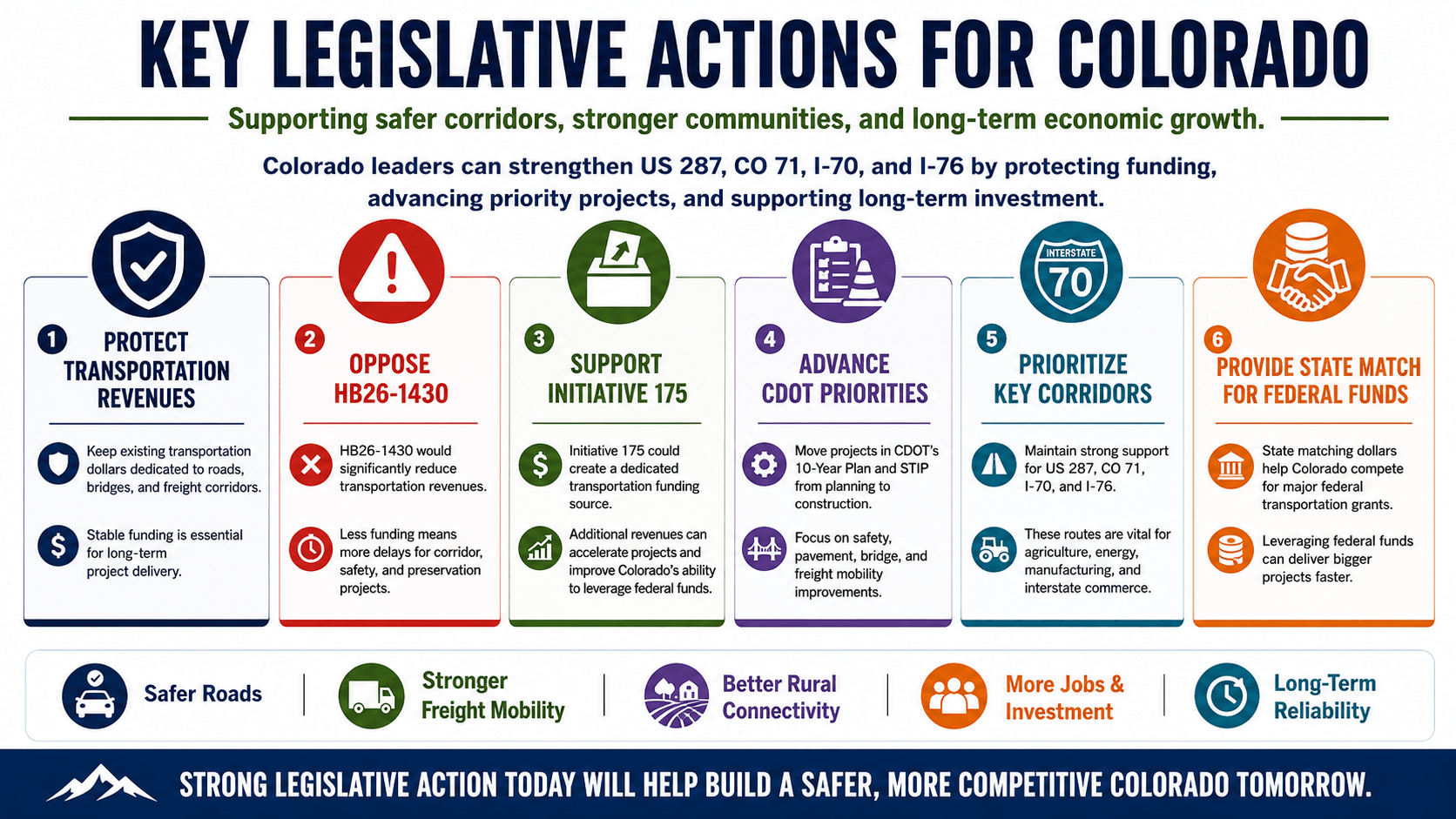
Colorado’s ability to maintain and improve its transportation network depends on stable and growing transportation revenues. While HB26-1430 would significantly reduce transportation funding available for highway, bridge, and freight corridor investments, Initiative 175 offers the potential to create a dedicated funding source that could accelerate transportation improvements across the state. Additional revenues generated through Initiative 175 could help advance major projects along the Ports-to-Plains Corridor, Heartland Expressway, I-70, and I-76, improve Colorado’s competitiveness for federal transportation grants, strengthen freight mobility, enhance roadway safety, and support long-term economic growth throughout rural and urban Colorado alike.

Economic Benefits
The Ports-to-Plains Corridor (US 287), Heartland Expressway (CO 71), I-70, and I-76 form the backbone of eastern Colorado’s freight transportation system, connecting agricultural producers, energy development, manufacturers, military facilities, and rural communities to national and international markets. These corridors are particularly important because eastern Colorado serves as one of the state’s primary agricultural production regions, supporting a sector that generates approximately $47 billion annually in economic activity and supports more than 195,000 jobs statewide.
Colorado’s economy depends heavily on the efficient movement of goods. According to CDOT’s freight planning data, approximately 201 million tons of freight move on Colorado’s highway system annually, with Interstate corridors such as I-70 and I-76 carrying some of the state’s heaviest truck volumes. Freight mobility improvements reduce transportation costs, improve supply chain reliability, and strengthen the competitiveness of Colorado businesses.
These eastern Colorado corridors also play an important role in supporting international trade. Colorado exported approximately $28 billion in goods and services in 2023, while agricultural exports totaled approximately $2.0 billion in 2024, including significant exports of beef, grains, and other agricultural commodities produced throughout eastern Colorado. Improved highway infrastructure allows producers and manufacturers to access domestic and global markets more efficiently and helps attract future private-sector investment.
The importance of these routes continues to grow as North American trade expands. In 2024, freight trade between the United States, Canada, and Mexico reached $1.6 trillion, with trucks carrying approximately $1.0 trillion of that commerce. The Ports-to-Plains Corridor provides a critical north-south connection linking Colorado to Texas, Mexico, and major domestic markets, positioning eastern Colorado to benefit from increasing USMCA-related trade and manufacturing growth.
Within eastern Colorado specifically, CDOT identifies US 287, CO 71, I-70, and I-76 as designated Colorado Freight Corridors, recognizing their importance to statewide commerce and economic development. The Eastern Transportation Planning Region notes that the nationally designated Ports-to-Plains Corridor and Heartland Expressway serve as critical freight connectors for agricultural shipments, interstate commerce, and regional economic activity throughout the Great Plains.
Support in the Colorado Legislature
Now is the time to continue building support for eastern Colorado’s transportation priorities in the Colorado General Assembly. Legislative support is essential to protect transportation revenues, maintain long-term funding commitments, and advance critical projects along the Ports-to-Plains Corridor (US 287), Heartland Expressway (CO 71), I-70, and I-76. These corridors serve as vital connections for agriculture, energy production, manufacturing, military readiness, interstate commerce, and rural communities across the state. As Colorado faces growing transportation demands and increasing project costs, lawmakers must continue prioritizing investments that improve safety, strengthen freight mobility, preserve existing infrastructure, and leverage available federal funding opportunities.
Stakeholders are encouraged to work with their state senators and representatives to support sustainable transportation funding, advance projects identified in CDOT’s 10-Year Plan and Statewide Transportation Improvement Program (STIP), and oppose measures that would significantly reduce transportation revenues. Strong legislative leadership can help accelerate corridor improvements, improve Colorado’s competitiveness for federal grants, provide necessary state matching funds, and ensure that rural regions receive their fair share of transportation investment. Continued support in the Colorado Legislature will help deliver the infrastructure needed to strengthen economic growth, improve connectivity, enhance roadway safety, and support the long-term development of eastern Colorado and the broader Great Plains transportation network.