
Nebraska Implementation
Getting Big Red Moving
The Heartland Expressway Association (HEA) approaches state policy with a disciplined, corridor-focused strategy centered on building long-term partnerships and securing sustained investment at the state level. Working closely with state departments of transportation, governors, and legislators in Nebraska, Colorado, and South Dakota, the HEA advocates for consistent funding, inclusion in statewide transportation plans, and prioritization within each state’s expressway system. The Association emphasizes data-driven decision-making, safety improvements, and freight mobility benefits to align corridor projects with broader state goals. By supporting dedicated funding programs, advancing phased project delivery, and coordinating multi-state messaging, the HEA ensures the Heartland Expressway remains a top policy priority and continues progressing toward Future Interstate standards.
Corridor Successes
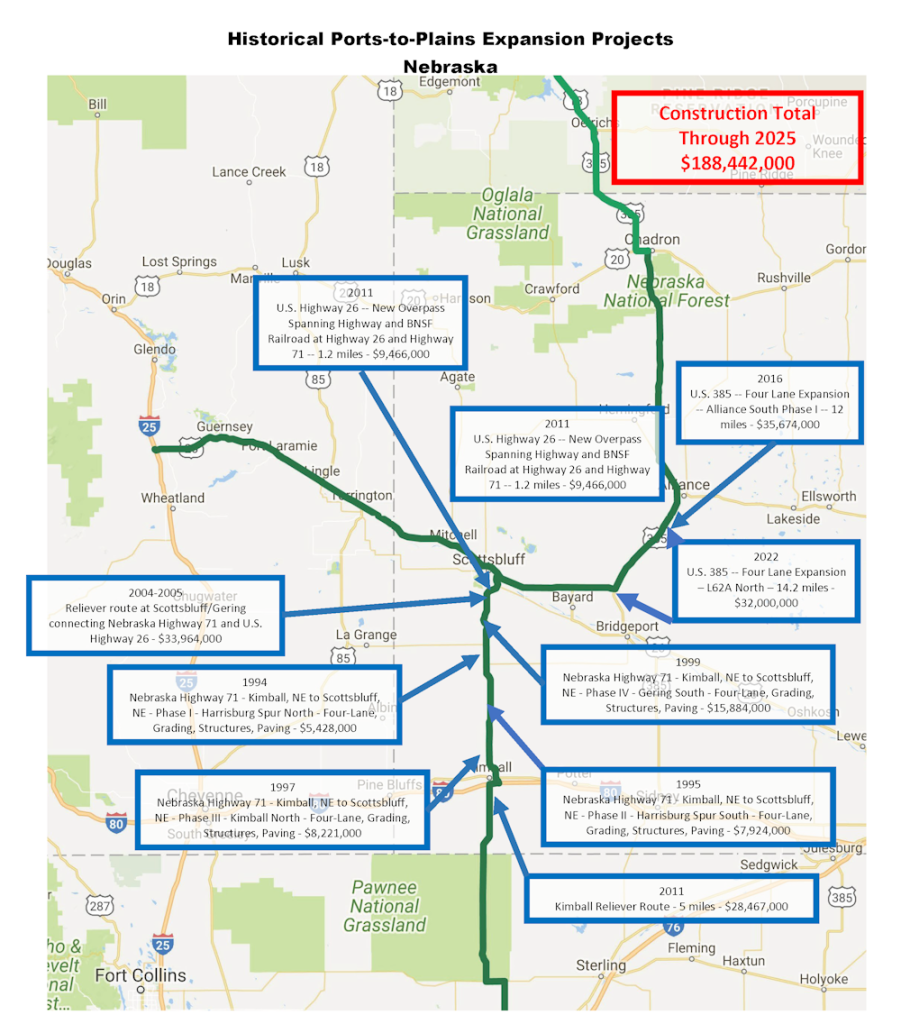
The Heartland Expressway in Nebraska demonstrates a proven record of corridor success through sustained investment, phased project delivery, and measurable infrastructure outcomes. Since the 1990s, more than $188 million in construction investment through 2025 has advanced key segments of US-385, US-26, and NE-71, delivering four-lane expansion, safety upgrades, and critical connectivity improvements across western Nebraska. These projects have strengthened freight mobility, reduced travel times, and enhanced access between rural communities, regional trade centers, and interstate systems. The corridor’s steady progress reflects a successful model of state leadership, local partnership, and long-term planning, positioning the Heartland Expressway as a vital component of the Ports-to-Plains Corridor and a future Interstate-ready route supporting economic development, agriculture, and North American trade connectivity.
What Is Coming?
The next phase of development for the Heartland Expressway in Nebraska focuses on advancing critical segments of US-26 and US-385 through a coordinated, phased investment strategy that continues progress toward a four-lane divided, Future Interstate-ready corridor.
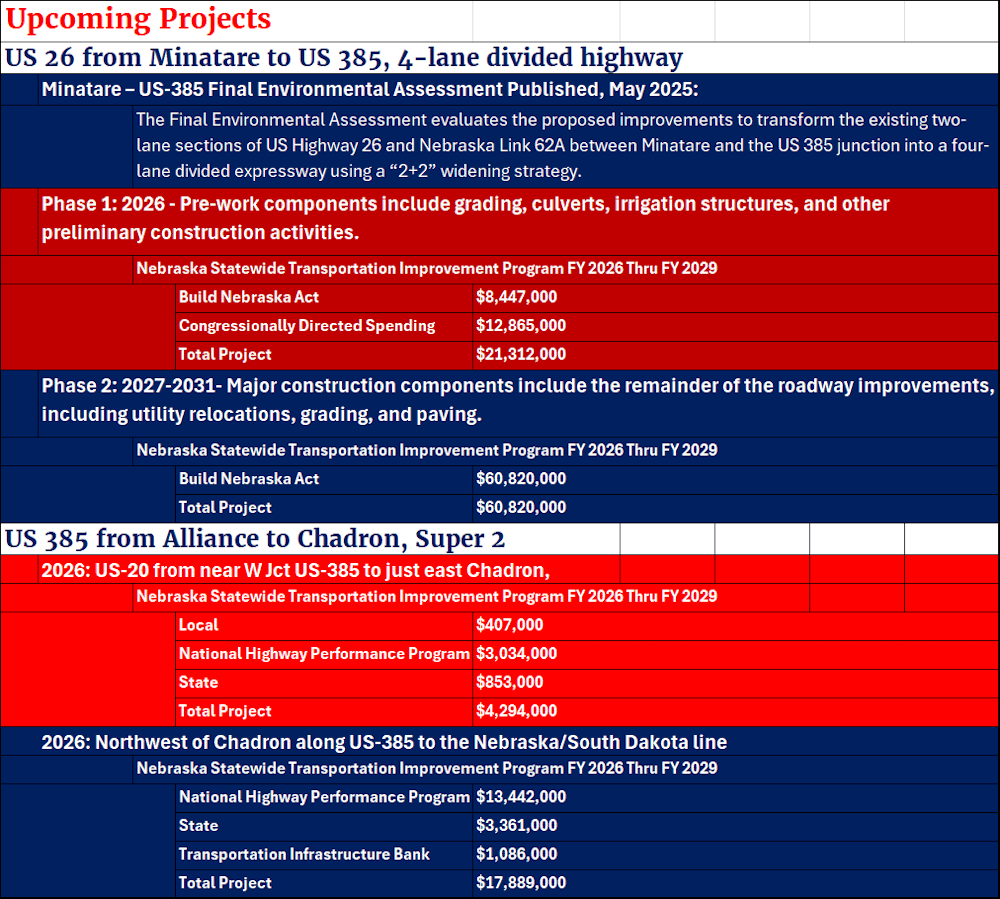
The US-26 Minatare to US-385 project represents a major priority, with the Final Environmental Assessment completed in May 2025. This project will upgrade existing two-lane sections and Nebraska Link 62A into a four-lane divided expressway using a “2+2” widening approach. Phase 1 begins in 2026 with pre-construction activities, including grading, culverts, and irrigation structures, supported by a combination of Build Nebraska Act funding and Congressionally Directed Spending. Phase 2, scheduled from 2027 to 2031, will deliver full construction of the corridor segment, including paving, utility relocation, and final roadway improvements.
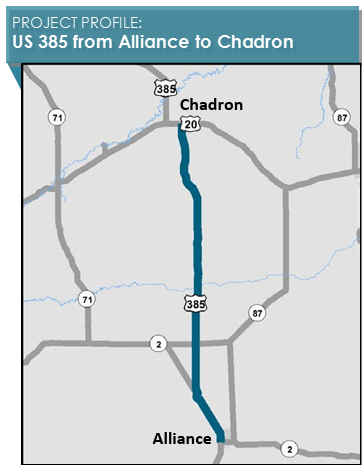
Additional investments along US-385 from Alliance to Chadron will advance the corridor through Super-2 and targeted capacity improvements. Projects beginning in 2026 include upgrades from US-20 near Chadron and continued improvements north toward the South Dakota state line. These efforts are funded through a mix of National Highway Performance Program funds, state investment, local contributions, and support from the Nebraska Infrastructure Bank.
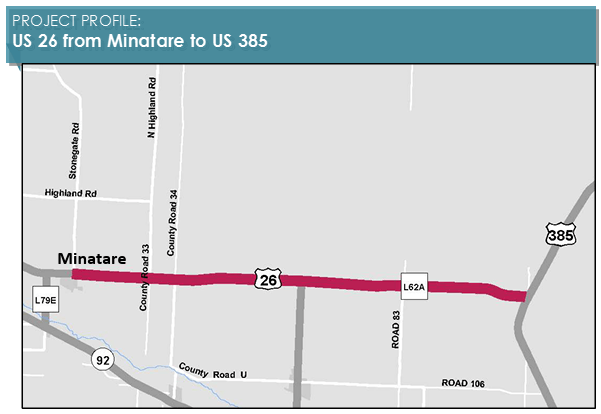
4-lane divided expansion advancing with Phase 1 construction beginning in 2026 and full buildout through 2031.
US-385: Alliance to Chadron
Super-2 and targeted upgrades improving safety, capacity, and connectivity north to South Dakota.
$100M+ Programmed Investment
Supporting corridor expansion, freight mobility, and Future Interstate readiness.
Key Nebraska State Funding
The Build Nebraska Act (BNA), enacted in 2011, established a dedicated, long-term funding source for transportation infrastructure by directing one-quarter of 1% of the state’s general sales tax to the State Highway Capital Improvement Fund. The legislation was introduced by State Senator Deb Fischer, then Chair of the Transportation and Telecommunications Committee in the Nebraska Legislature, creating a sustainable investment strategy for Nebraska’s highway system.
Under the BNA, 85% of revenues support highway expansion projects—including the Expressway System and high-priority corridors—while 15% is distributed to local governments for road improvements. Extended in 2023 through 2042, the program is projected to generate approximately $3.5 billion statewide.
The BNA has been instrumental in advancing the Heartland Expressway, delivering hundreds of millions of dollars—estimated between $400 million and $600 million—for key segments. These investments have accelerated four-lane expansion, improved safety, and strengthened freight mobility across western Nebraska.
Projects completed funded with BNA Funds:
- US-385 L62A to Alliance 4-Lane Divided Highway
The Nebraska Infrastructure Bank (NIB), established in 2023 by the Nebraska Legislature, is a flexible, revolving financing tool designed to accelerate transportation and infrastructure projects across the state. Administered by the Nebraska Department of Transportation (NDOT), the NIB provides low-interest loans—rather than grants—to help advance high-priority projects, including key corridors like the Heartland Expressway. By offering upfront capital, the program enables state and local entities to move projects forward more quickly, leverage federal and state funding, and bridge gaps between project phases. The Infrastructure Bank is capitalized through state appropriations, eligible federal funds, and loan repayments, creating a sustainable funding cycle that reinvests dollars over time. While smaller in scale than dedicated funding programs like the Build Nebraska Act, the NIB plays a critical role by increasing flexibility and speeding up project delivery, particularly for rural infrastructure improvements.
In addition to the Build Nebraska Act, Nebraska supports transportation infrastructure through a range of other state funding sources administered by the Nebraska Department of Transportation (NDOT). These include traditional highway funding streams such as state fuel taxes, vehicle registration fees, and allocations from the Highway Trust Fund, which provide ongoing revenue for system preservation, maintenance, and capacity improvements. The state also utilizes programs like the Nebraska Infrastructure Bank to offer flexible financing, along with periodic legislative appropriations for targeted priorities. Together, these funding sources enable Nebraska to match federal funds, advance high-priority corridors such as the Heartland Expressway, and maintain a balanced approach between expanding the highway system and preserving existing assets.
Corridor Development & Management Plan
The Heartland Expressway Corridor Development and Management Plan (CDMP), published in 2014 was developed to guide the long-term planning, development, and implementation of the Heartland Expressway within Nebraska, following its designation as a High Priority Corridor under the federal Transportation Equity Act for the 21st Century (TEA-21). As part of the broader Ports-to-Plains Alliance Corridor connecting Canada to Mexico, the plan establishes a coordinated framework to advance a high-speed, north–south corridor that enhances freight mobility, improves safety, and supports economic development across the Great Plains. The CDMP fulfills federal requirements by outlining a comprehensive strategy that includes project phasing, environmental review, cost-benefit analysis, financing approaches, and identification of potential development challenges. Ultimately, the plan serves as a roadmap for delivering a four-lane divided highway system—implemented through phased improvements—to strengthen regional connectivity and position the corridor for future Interstate standards.
Economic Benefits
The Heartland Expressway Corridor delivers significant transportation, economic, and regional benefits that strengthen Nebraska’s role in the national and international freight network. The plan identifies measurable improvements in travel efficiency, safety, and economic competitiveness, positioning the corridor as a critical north–south connection across the Great Plains.
Key transportation benefits include reduced travel times for both passenger vehicles and freight, improved reliability, and more efficient routing as traffic shifts from slower parallel routes to a higher-speed facility. The corridor also enhances safety through roadway upgrades and modern traffic management systems, resulting in substantial reductions in crashes, injuries, and associated costs.
From an economic perspective, the improvements generate over $450 million in total benefits (2012 dollars) through travel time savings, accident reduction, and logistics efficiencies. Freight movement becomes more reliable and cost-effective, enabling businesses to reduce inventory costs, streamline operations, and access broader markets—particularly for Nebraska’s agriculture and food processing sectors.
The corridor also drives job creation and long-term economic growth, supporting construction employment, ongoing operations jobs, and expanded private-sector investment. The plan estimates 10,000 to 36,000 job-years and up to $943 million in earnings across the region over time. Increased traffic along the corridor further supports local economies by boosting demand for lodging, fuel, food services, and retail activity.
At a broader level, the Heartland Expressway strengthens regional and national connectivity, linking rural communities to major markets, improving access between agricultural production areas and processing centers, and providing an alternative route to congested urban corridors. These combined benefits enhance the competitiveness of the Great Plains economy while advancing the corridor toward Future Interstate standards.
Support in the Nebraska Legislature
Now is the time to move I-27 forward in Nebraska. Urge your state legislators to support continued funding and ask Nebraska to continue prioritizing the corridor. Sustained legislative support ensures planning, construction, and long-term delivery of this nationally significant Corridor.