January 2026 Volume 24 Issue 1
|
We are a voice for our small town, grassroots members who may otherwise not have access to the right audiences, as well as a conduit for industry to come together in support and promotion of transportation improvements.
We are committed to working as an Alliance to improve transportation infrastructure and business networks opportunities, by advocating for appropriate funding levels, so business and industry can thrive.
We are focused on the economic and business interests that are the lifeblood of the region.
|
Be Sure Newsletter Email is Allowed
|
As you may have noticed, the monthly Ports-to-Plains Newsletter is sent through our member database. Please be sure the email address pal@memberclicks-mail.net is allowed on your system.
|
At the beginning of the month, I had the privilege of speaking at the New Mexico Transportation and Paving Conference hosted by the University of New Mexico. My speaking time was during the opening general session, and I followed a well-done video presented by New Mexico Transportation Secretary Ricky Serna honoring the 100th Anniversary of Route 66 or the “Mother Road”. As it turns out, New Mexico has more miles of the original Route 66 roadbed than any other state. So now it is my turn to speak, and I reach the point in my presentation when I am describing the evolution of our national interstate system, and particularly the construction of interstates in New Mexico, and I have this “Cars” moment with a vision of Radiator Springs being bypassed by Interstate 40. Many would say that the construction of Interstate 40 was the death of the “Mother Road” in Oklahoma, Texas, New Mexico, Arizona and parts of California. I would say that is partially true. What really died was a certain way the American traveling public experienced driving the road. As the interstate system came online, people’s driving habits changed. We are such a monochronic society, it becomes all about getting from point A to Point B. We don’t stop and smell the roses, or see the world’s largest ball of yarn, or take a picture of the Cadillacs half buried in the ground because we don’t take the time to do so. Even the roadside picnic areas have become obsolete and replaced with truck parking. We just don’t travel that way anymore.
|
I would however like to make an argument that the improvement of our transportation highway network, including the creation of the interstate system, has given us access to more natural wonders, historic sites, and tourist oddities than we could have ever imagined. I would like to share with you one of our family vacations to prove the point. The trip was an Alaskan cruise in early July that ported out of Vancouver British Columbia. We prefer to drive than fly to our destinations, so the plan was to leave a week early, drive west and follow the California coastal highway up through Oregon and Washington to Vancouver. When we finished the cruise, we would take our time and work our way home through Idaho, Montana, Wyoming and Yellowstone, the Grand Teutons, and so on, back to Abilene. This type of travel includes stopping at roadside fruit stands to try the local fruit, stopping at state lines to take pictures at the entry signs, Old Faithful, and other interesting places. But this trip did not happen the way I described it. Earlier that year we were given notice that Brooke’s local dance studio was going to celebrate their 50th Anniversary by taking a trip in late July to Disney World in Orlando Florida. How were we, without flying, going to be in Vancouver in early July and Orlando in late July? The only way was to cut out the meandering drive including the California coastal road, and drive as straight as possible from point A to point B. For example, we left Abilene on Thursday and were in Vancouver by that Saturday. We got off the ship on Monday, and we were back in Abilene by that Wednesday. But now for the realization moment. Ketta had made Brooke keep a diary of our trip journey including tracing the route on those AAA paper maps. I was asked to add notes to the diary along the way, and this was how my entries read; Today we almost saw Four Corners New Mexico, today we almost saw the Bonniville Salt Flats Utah, today we almost saw Mount Rainier in Washington, today we almost saw Glacier Park Montana. All we saw were the signs that said we were that far from all these places. We did, however, see Old Faithful, but it was more like a drive by. Ketta was driving and kicked us all out in the parking lot, and we ran up to the geyser, and it blew, we took pictures, and we ran back to the parking lot and kept driving. The point is this, even though we had to truncate our trip, given enough time, having an improved national transportation system including our interstates, gives us access to remote and wonderful places that a hundred years ago we could have only dreamed of.
One of the purposes and need for an interstate corridor up through the midwestern United States is the impact that this improvement would have on tourism. Being able to connect Mount Rushmore in the Rapid City area with the new Theodore Roosevelt Presidential Library in Medora North Dakota will give travelers access to these incredible destinations, allowing travelers from as far south as Texas to enjoy these wonderful attractions. Building this interstate will also allow travelers from North Dakota and Montana to experience National Parks in Texas like Big Bend, or beautiful beaches in places like South Padre. And the list could go on, if we take the time.
more to come …
Lauren D. Garduño
|
Washington DC Fly-in - March, 2026
|
This has been an exciting year for federal policy. Big ideas are on the table. Never have we had more on the line than this year. The opportunities are staggering. Please consider joining us in DC. Note the Hotel Block Deadline Below.
|
What is on the line? - Future Interstate Formula Funding Program
- Interstate Feasibility Study for Seven States
- Current and Future Congressionally Directed Spending and Community Project Funding
Hotel Block Deadline is: 5PM on Friday February 6th, 2026
The Ports-to-Plains Alliance requests participation from your organization for the 2026 Washington DC Fly-in scheduled March 2-5, 2026. Please share this with your members. This Fly-in, like those in the past, will have a significant impact. It is our annual opportunity to show the variety of organizations supporting the Ports-to-Plains successes, needs and policy positions.
The Ports-to-Plains Alliance Federal Lobby Team from Hance Scarborough LLP will attempt to schedule meetings with all Senate and House members, and/or Staff, and federal agencies along the nine-state Corridor.
The Alliance will also provide Federal Policy Priorities to share with members and agencies. Participants will be scheduled into meetings with a priority to participate in meetings with their state members of Congress. We try to schedule at least 3-5 participants into each meeting with a mix of experienced and new participants.
|
What will be on the Agenda? - Successes from the past year
- Vision for the Corridor
- Reauthorization of the Transportation Bill
- Multi-state Future Interstate Formula Funding Program
- Interstate Feasibility Study
- Designation and Numbering for an expanded I-27
- Formula funding to State DOTs
- Value of Congressionally Directed Spending and Community Funding Projects through the Appropriations process
- Importance of Funding Rural Corridors
|
THE ALLIANCE NEEDS PARTICIPATION FROM EACH STATE AND CONGRESSIONAL DISTRICT.
Date: March 2-5, 2026
Schedule: - Sunday March 1st - Travel
- Monday, March 2nd – Travel and Ports-to-Plains Alliance Board Meeting at 4:30 PM EST
- Tuesday, March 3rd – U.S. House of Representatives Office Meetings
- Wednesday, March 4th – U.S. Senate Office Meetings
- Embassy Suites by Hilton Washington DC Georgetown
- Rooms will be available from Sunday, March 23rd to Friday, March 28th
- Cost: $259 per night
- Thursday, March 5th – Overflow Congressional and Agency Meetings
- Friday, March 6th - Travel
Hotel:
Please find the booking link below for the Ports-to-Plains DC Fly-In group, arriving from March 1, 2026, to March 6, 2026. If guests prefer to call in, they can use the 3-letter code P2P. Please ensure all rooms are reserved before the cutoff date of 5PM on Friday February 6th, 2026 to take advantage of your group rate discount.
Booking Link
|
2025 Ports-to-Plains Alliance Progress Report
|
This question addresses Marketing Successes. - New Members:
- Business - Chairman's Circle: J Lee Milligan, Inc.; Texas Tech University - College of Engineering
- Business - President's Circle: RRP Consulting Engineers, LLP; Terracon; Halff
- Business - Other Associate: BGE, Inc.; MV Engineering, Inc.; Tom's Tree Place; RS&H; Park Construction Co.
- Business - Small – Associate: ALL-Ways Engineering, LLC
- County: Schleicher County
- Municipality: City of Midland, Texas; City of Odessa Texas
- Website: portstoplains.com
- 25,112 Active Users in 2025, an increase of 53.7% over 2024
- 51,088 Page Views in 2025
- Newsletter Database: 263 added in 2025
- Total Members: 108 Organizations
|
This question addresses Legislative Successes. - Federal Proposals
- Multi-state Future Interstate Formula Funding
- Initially working with the I-69 Alliance and I-14 Coalition, this effort has expanded into the Congressionally Authorized Future Interstate (CAFI) Coalition hoping to involve the additional ten Multi-state Future Interstate Corridors.
- The call is for a return to a National Vision like the original Interstate System.
- The Solution:
- Congress should make a Multi-State Future Interstate Highways Formula Funding program part of the next federal surface transportation reauthorization bill with dedicated funding.
- Funding would be distributed to State DOTs based on the number of unconstructed, multi-state authorized Future Interstate miles in each state.
- States would be required to use the formula funding to plan and construct multi-state interstates.
- Guaranteed federal funds for the program would be in addition to each state’s Highway Trust Fund rate of return calculation.
- States would have the flexibility to determine annual priorities for corridor development.
- 10% of funding for planning High Priority Corridors for Future Interstate Status. 90% for Development and construction on existing Multi-state Future Interstate Highways.
- Interstate Feasibility Study
- Make the Future Measurable
- What are the Safety Benefits for Upgrading the Corridor to an Interstate?
- What is the Travel Time Benefit of Upgrading the Corridor to an Interstate?
- How will the Interstate Improve Freight Movement?
- How will the Interstate Help the Energy Industry Get Products to Market?
- How will the Interstate Help the Tourism Industry?
- How will the Interstate Improve Congestion and Reliability?
- What is the Cost to Upgrade the Corridor to an Interstate?
- What are the Economic Impacts and Return on Investment of an Interstate Upgrade?
- Long-term Economic Returns for Upgrading the Corridor to an Interstate
- Determination of Areas Preferable and Suitable for Interstate Designation
- What are the Potential Funding Sources for an Interstate Upgrade?
- This study would cover the remaining seven Corridor States.
- Support: Currently we have sixty-six supporting organizations.
- Designation and Route Numbering
- This action would make the remaining seven Corridor States eligible for Multi-state Future Interstate Formula Funding.
- Support: Currently we have eighty-two supporting organizations.
- Washington DC Fly-in 2025
- Participation was very good: Colorado (1), Nebraska (3), New Mexico (2), North Dakota (5), South Dakota (1), Texas (8) and our state and federal consultants (3). Meetings were held with every U.S. House Office along the corridor (17) and all but one U.S. Senate Office (17).
- Key Talking Points: Why Build? Food, Fuel and Fiber
- Federal Reauthorization
- Congressional Funding Requests
- Use for Planning
- Coordinate with State DOTs
- Relevance to the Area (Agriculture, Energy, International Trade, Military/Defense)
- Progress Update
- I-27 Signage Ceremony (April 14th Lubbock)
- At each meeting the participants left behind the Ports-to-Plains Alliance 2025 Federal Policy Priorities. CLICK HERE to Download.
- FY 2026 Appropriations in Current Legislation
- These 2026 Congressional Requests are awaiting final action by Congress
- U.S. House Community Planning Funding
- Congressman Jodey Arrington (TX-19) has:
- $640 thousand for Study of Operational Improvements Lamesa One-Way
- $5.0 million for Operational Improvements Lamesa One-Way
- Congressman Ronny Jackson (TX-13) has two projects:
- SL 335 - Upgrade to Freeway- Amarillo from West of FM 2590 to (South) to FM 2186 (TxDOT Project ID 2494-02-011) at $1.0 million
- City Location Study at Dumas at $1.0 million
- Congressman August Pfluger (TX-11)
- Future Interstate Planning between San Angelo and Sonora for $1.0 million
- Congresswoman Teresa Leger Fernandez (NM-3)
- $1.0 million for Interstate Planning Funds for City Location Study at Raton
- Congresswoman Lauren Boebert (CO-4)
- $2.0 million for SH 71 Corridor Improvements Project (Heartland Expressway)
- Senators Martin Heinrich (NM) and Ben Ray Luján (NM)
- $1.6 million in play for Interstate Planning Funds for City Location Study at Raton
- Senator Deb Fischer (NE)
- $5.0 million for Chadron North to Nebraska/ South Dakota state line
- Support: Currently we have ninety-one supporting organizations.
- U.S. Senate Congressionally Designated Projects
|
This question addresses Development Successes. - FY 2026 Texas UTP
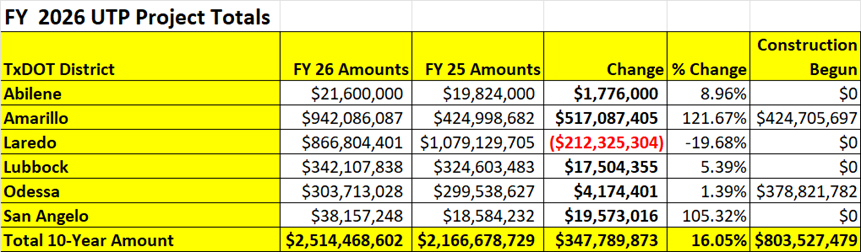
- The Texas FY 2026 Unified Transportation Program (UTP) was adopted in August 2025. The UTP is TxDOT’s annual 10-year plan that guides the funding development of transportation projects across the state, identifies how much transportation funding the state expects to have over the next decade and how to distribute it to address TxDOT’s strategic goals, and includes all transportation projects that TxDOT is developing for construction over the next 10 years.
|
- That is progress! But there is more to the story about investment in projects benefiting the Ports-to-Plains Corridor in Texas. Annually, the Ports-to-Plains Alliance reviews projects in the UTP. In 2025, projects benefiting the Ports-to-Plains Corridor totaled about $2.17 billion. In the approved FY 2026 UTP, projects totaled $2.51 billion. $803.5 million of projects in the FY25 UTP are not in the 2026 UTP because those projects began construction. Exciting increase in investment in the Ports-to-Plains Corridor in Texas.
- I-27 Advisory Committee met twice in 2025
- The I-27 Advisory Committee created by SB 1474 in 2021, met on April 10, 2025 in Austin, Texas.
- TxDOT is currently seeking dual designation for 18.25 miles of I-27/I-35 in Laredo.
- High-level summary of the current TxDOT investment on the future I-27 corridor, including those on the 2025 Unified Transportation Program (UTP) or under planning stages outside of the UTP. Summarized totals assigned for I-27 development included planning funding ($7.6B) meant for preliminary studies; engineering funding ($2.7B) meant for development of schematic designs and other requirements needed to secure construction funding; and programmed construction funding ($3.3B).
- I-27 Dashboard was introduced, emphasizing its role in dynamically showcasing progress on the I-27 Implementation Plan. The dashboard will provide detailed metrics to track each project's status against the Implementation Plan and offer insights into each district's performance in securing funding.
- Link to Presentation: https://www.txdot.gov/content/dam/docs/division/tpp/i-27-advisory-committee/i-27-ac-mtg9-presentation.pdf
- The I-27 Advisory Committee, created by SB 1474, met on I-27 Advisory Committee Meeting on September 4, 2025 in Del Rio, TX for its second meeting in 2024.
- Development of U.S. 85 in North Dakota
- North Dakota Funding Approval
- 6.5 mile stretch from the Long X Bridge to RP120 (the top of the breaks).
- NDDOT received 5 bids ranging between $83.8 million and $102 million. The apparent low bid of $83.8 million was from Park Construction Company headquartered out of Minneapolis, MN.
- 3 miles of U.S. 85 from a point six miles south of the Long X Bridge to the junction with Highway 200 (Jct. ND 200 to RP120)
- NDDOT received 3 bids ranging from$61.8 million and $73.8 million. The apparent low bidder was STRATA Corporation headquartered out of Grand Forks, ND
- Ribbon-Cutting Ceremony Celebrates First New Segment of Interstate 27
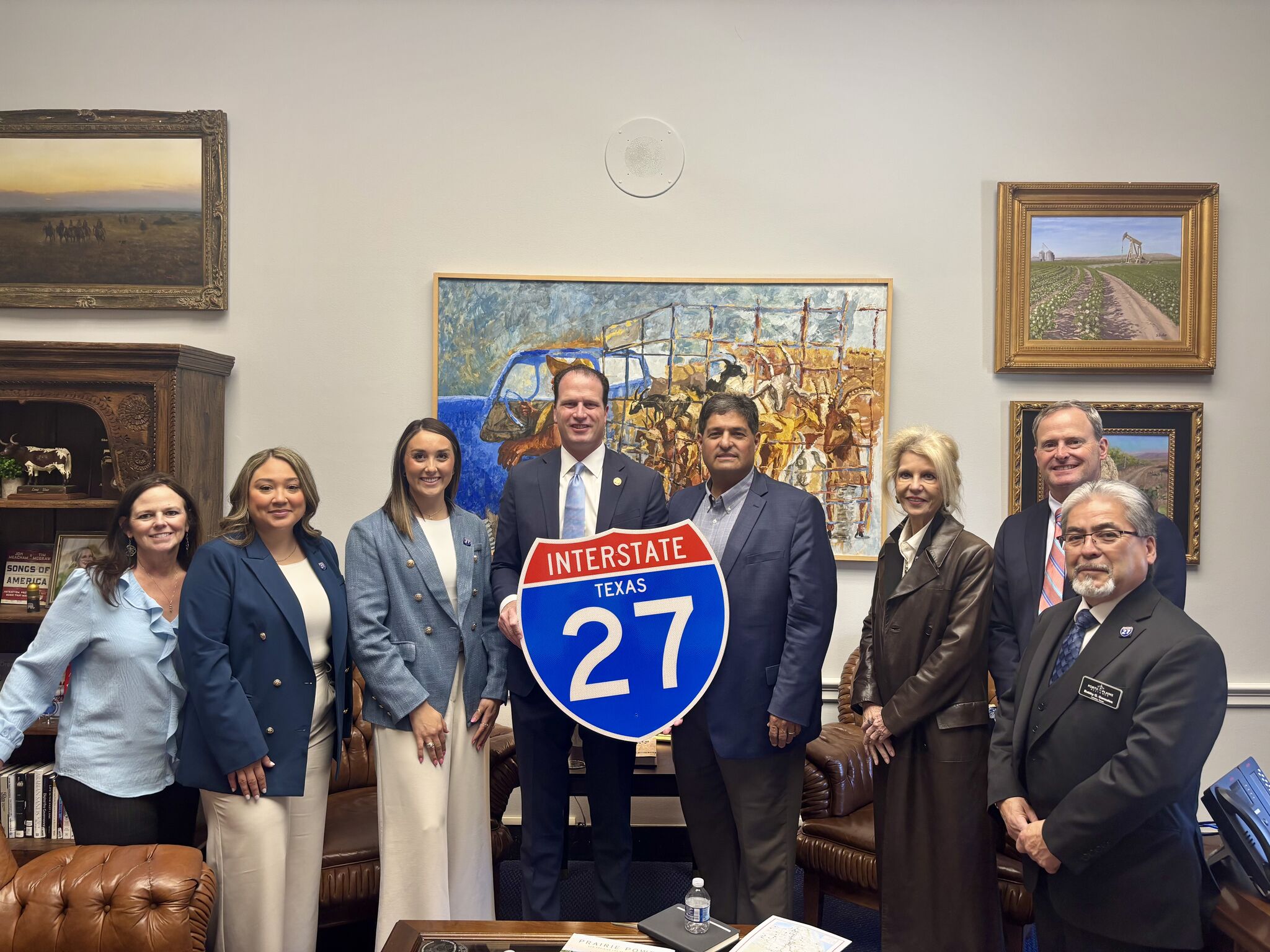
- I-27 signage ceremony in Lubbock on April 14th,2025 celebrating AASHTO’s approval of 4.2 miles of new I-27 interstate completed south of the City of Lubbock.
- US 64/87 Ports-to-Plains Feasibility Study (NM)
- “The New Mexico Department of Transportation is in the process of finalizing a contract with Parametrix to prepare the Phase I-A/B report for the US 87/US 64 sections of the Ports-to-Plains Corridor (Proposed I-27). The study will kick off in Spring 2026 and is expected to take 18 months to complete. The team is enthusiastic about partnering with the P2P Alliance and engaging stakeholders throughout the corridor.” -- From Parametrix
- Technical Description of Project: This is a study regarding the Future Interstate Highway along the Ports-to-Plains Corridor (US 87/64) between the New Mexico-Texas state border and Raton. The Future Interstate Highway has potential to provide positive economic development impacts for northeast New Mexico.
- TxDOT Completes IH-27 Feasibility Study from Amarillo to Dumas
- The Texas Department of Transportation's (TxDOT) Amarillo District completed the study in July 2025. As a result of the concept development process and stakeholder and public engagement, alternatives were recommended for the three segments of the I-27 Feasibility Study area. For the SL 335 segment in Amarillo, interstate upgrades are recommended on the west side of the loop as well as a direct I-27 Feasibility Study Report | 1 connector interchange at SL 335 and I-27. For the US 87/US 287 segment between Amarillo and Dumas, ten proposed interchange locations were identified as well as frontage roads in addition to interstate upgrades. For the Dumas Area, a new location was identified for the future I-27 corridor. A Full Loop Alternative was recommended for interstate upgrades to avoid and minimize impacts to resources as well as provide access to the Dumas urban core in alignment with community needs. Following this study, the SL 335 segment will undergo the interstate designation process upon completion of ongoing construction. Following the completion of this feasibility study, the next phase in the implementation plan will be preliminary design.
- Link to Study Report:
|
I-27 Advisory Committee Meeting in Big Spring, Texas
|
This is a Save the Date for the next I-27 Advisory Committee Meeting scheduled for Thursday, April 9, 2026, from 9:00 a.m. to 11:30 a.m. in Big Spring, Texas. The meeting will be held at Hotel Settles, 200 East Third Street, Big Spring, Texas 79720. If you can only participate virtually, a Teams link is included below.
|
What: I-27 Advisory Committee Meeting Date: Thursday, April 9, 2026 Time: 9:00 a.m. – 11:30 a.m. (Networking from 8:30 a.m. to 9:00 a.m.) CT Location: Hotel Settles 200 East Third Street Big Spring, TX 79720 Teams Link: https://bit.ly/I-27AC10 You can view information about the Committee, Fact Sheets, and previous meeting summaries on the webpage I-27 Advisory Committee.
|
Texas-Mexico Border Transportation Master Plan
|
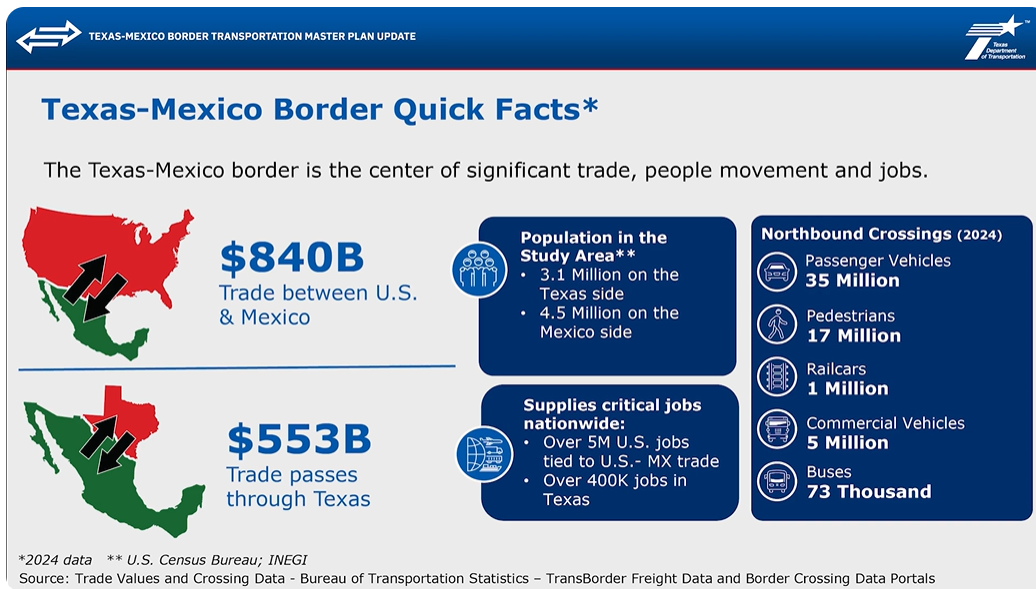
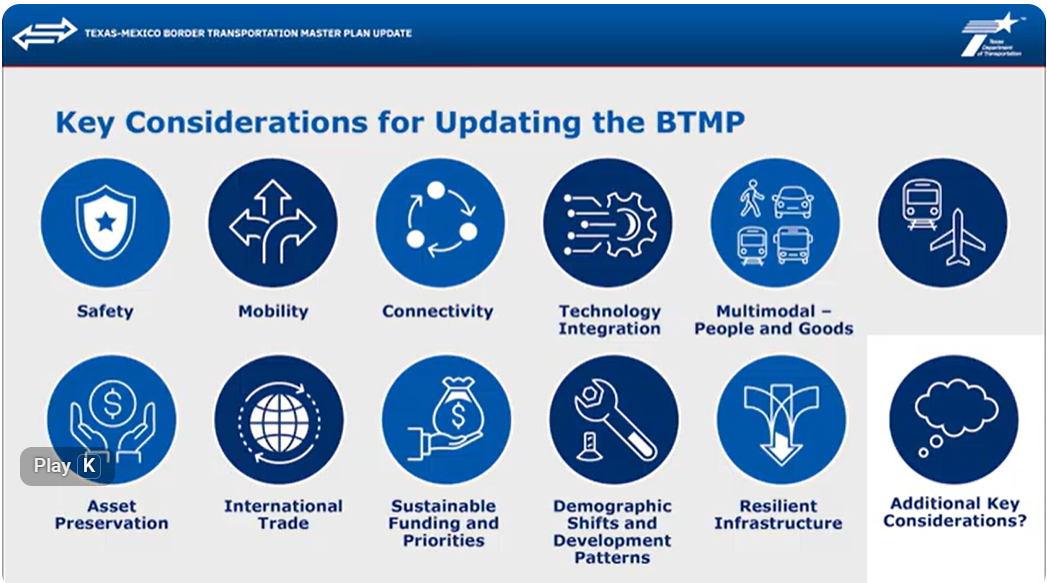
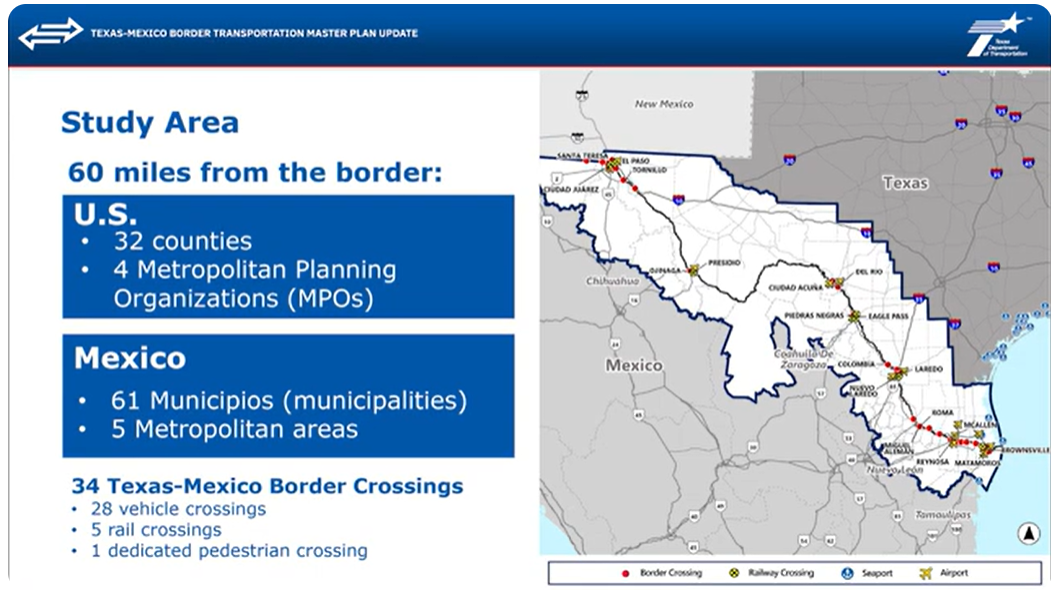
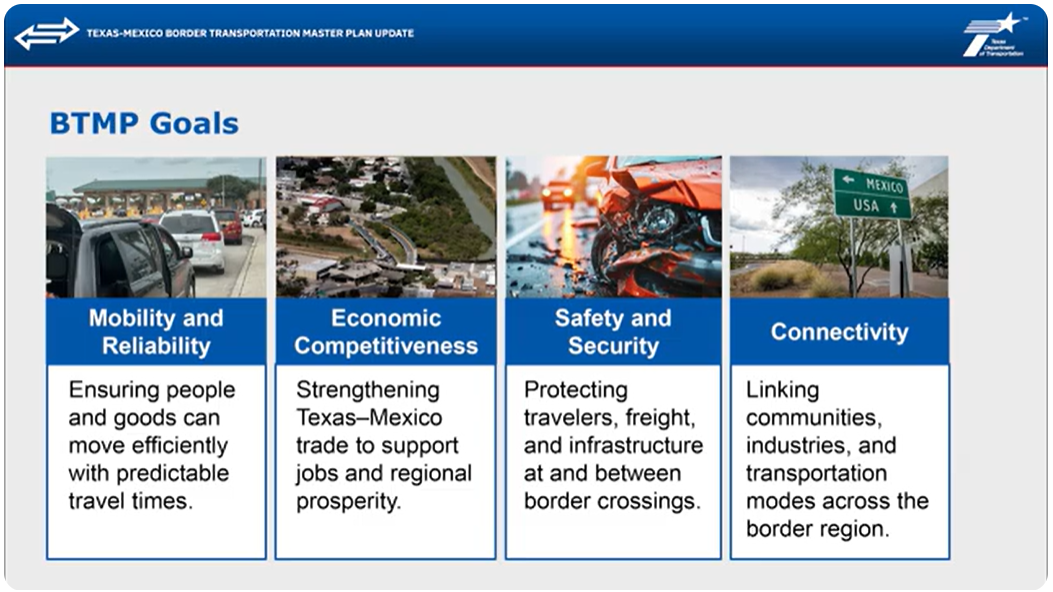
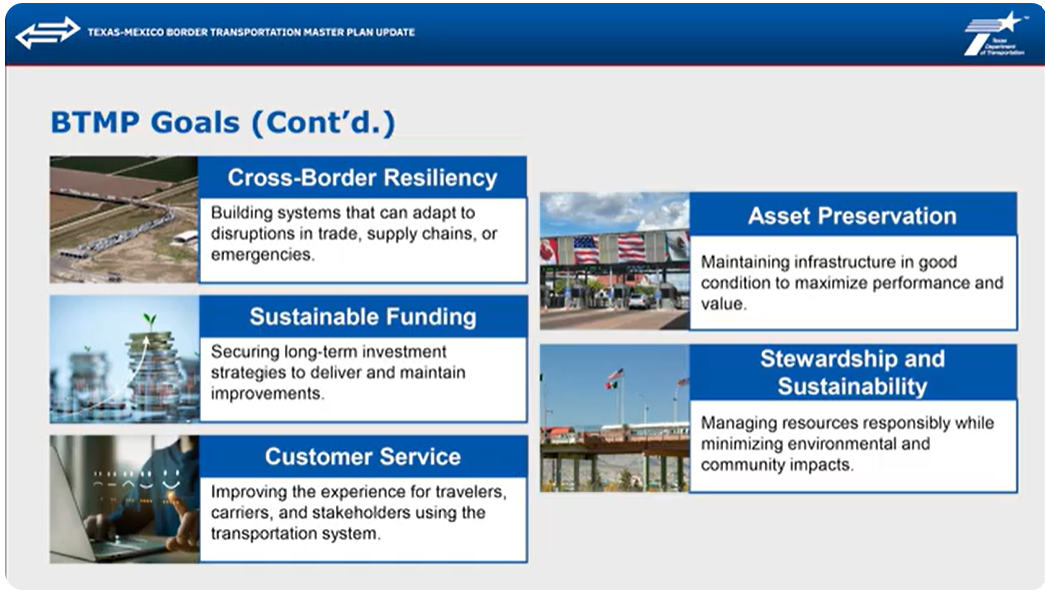
The Texas-Mexico Border Transportation Master Plan is a binational, comprehensive, multimodal long-range transportation plan. It identifies issues, needs, challenges, opportunities, and strategies for moving people and goods efficiently and safely across the Texas-Mexico border, the border region, and beyond. TxDOT, in collaboration with the Border Trade Advisory Committee, binational federal, state, regional, and private sector stakeholders are in the process of updating the Texas-Mexico Border Transportation Master Plan, adopted in 2021 by the Texas Transportation Commission.
The Ports-to-Plains Alliance urges you to provide input to the plan as the update moves forward.
The Texas–Mexico Border Transportation Master Plan matters to the Ports-to-Plains Alliance because it directly supports the Alliance’s core mission: strengthening north–south trade mobility between Mexico, the Texas border, and the central U.S. through a future Interstate-quality corridor.
|
Here’s why it’s strategically important: - Anchors the Southern End of the Corridor
Ports-to-Plains begins at international ports of entry along the Texas–Mexico border. The Master Plan prioritizes border crossings, freight facilities, and last-mile connectors that feed directly into the I-27 / Ports-to-Plains system. - Aligns Binational Trade with Interior Corridors
The plan links border investments to inland highways, rail, and logistics hubs—exactly the north–south connectivity Ports-to-Plains is advancing from Mexico to Canada. - Strengthens the Case for Federal Funding
Projects identified in the Master Plan are better positioned for IIJA and future reauthorization funding. When paired with a designated Future Interstate corridor, they form a compelling, nationally significant investment package. - Supports Economic Development Goals
Efficient border mobility boosts agricultural exports, energy production, manufacturing, and supply-chain reliability across the Ports-to-Plains states—core outcomes the Alliance advocates for.
Bottom line: the Texas–Mexico Border Transportation Master Plan ensures the Ports-to-Plains Corridor doesn’t stop at the border—it functions as a seamless, trade-ready backbone connecting North American markets end to end.
|
This prerecorded video presentation provides the public with an opportunity to learn about the Texas-Mexico Border Master Plan and provide input on what is important to those who live and work in the border region and what improvements to the transportation network would be beneficial.
|
Joe Kiely
Vice President of Operations
Ports-to-Plains Alliance
PO Box 758
Limon, CO 80828
Cell: (719) 740-2240
joe.kiely@portstoplains.com
|
Cal Klewin
Executive Director
Theodore Roosevelt Expressway Association
PO Box 1306
Williston, ND 58802
701-523-6171
cal@trexpressway.com
|
Deb Cottier
Chair
Heartland Expressway Association
c/o TCD
1820 Broadway
Scottsbluff, NE 69341
308-432-4023
dcottier@gpcom.net
|
|