July 2026 Volume 24 Issue 7
|
We are a voice for our small town, grassroots members who may otherwise not have access to the right audiences, as well as a conduit for industry to come together in support and promotion of transportation improvements.
We are committed to working as an Alliance to improve transportation infrastructure and business networks opportunities, by advocating for appropriate funding levels, so business and industry can thrive.
We are focused on the economic and business interests that are the lifeblood of the region.
|
Be Sure Newsletter Email is Allowed
|
As you may have noticed, the monthly Ports-to-Plains Newsletter is sent through our member database. Please be sure the email address pal@memberclicks-mail.net is allowed on your system.
|
As we continue to have the conversations about why we need a new interstate running through the midwestern United States, one of the recurring topics centers around value. If I am potential business owner or start up investor looking to locate a new business, the benefit of access to interstate corridors is usually always on the table. If I am a logistics supplier, I am always interested in the transportation savings that access to an interstate corridor will afford me. If I am an economic development director, my marketing campaign is strengthened when we can sell access to an interstate highway. And, as transportation professionals, we are always trying to explain in laymen’s terms the value of travel time savings by having an interstate corridor. But what about the rest of us who also work hard for a living, trying to make ends meet, and are living on a budget? What would be the value of access to interstate for us?
I would like to share with you the hidden costs of not having access to improved transportation corridors like interstate highways. I imagine that every one of us at some time has ordered a commodity that had to be shipped to a destination. How many times have you been enticed to buy a certain volume amount so that shipping is “free”? It is not free; the company was willing to eat the shipping cost because of the volume of your purchase. They can do this because the reduced shipping costs due to improved transportation corridors can be passed on to you. Sometimes the shipping questions center around weight and speed of delivery. You pay more for bulkier items and a premium for expedited delivery. Have you ever had a time when the product could not be delivered to your desired destination? Probably not because most of us live in some proximity to an improved transportation network.
|
I would, however, like to share with you an example of the increased costs of goods and services that are a result of non-access to improved transportation systems. I know that my example will be extreme, but it does help prove the point for better transportation access. On a recent family vacation, our trip included a cruise to Alaska. The northernmost destination was Skagway. Of course, I am always interested in the transportation systems in these remote areas. Highway access is limited, and the value of maritime and air transportation is evident. When you are looking for a topic besides the weather with the locals, the cost of common commodities that we take for granted every day will usually surface. So, while we were walking through town, we decided to conduct an experiment. We stepped into the local grocery store and started pricing certain items. A gallon of milk was priced at $9 dollars. You could get it at half-price if you bought milk approaching the expiration date. Ground beef was over $11 dollars a pound. We also noticed that your selection of items was limited. Not everything you wanted could get there.
I realize that we will not build an interstate to Skagway. But history has proven that we will always improve our prosperity and quality of life anywhere we can improve our transportation network. A two-lane paved road is better than a dirt road, a four-lane divided highway is better than a two-lane paved road, and an interstate highway is better than a four-lane divided highway. And with each upgrade comes new business opportunities, reduced shipping costs, thriving economies, and faster travel times. And maybe access to some of our favorite things too.
I want to close with an invite to our Annual Conference to be held on September 8-10, 2026, in Acuña, Coahuila and Del Rio, Texas. We have a great line up of speakers on interesting topics and are looking to make a big splash with announcements from both Mexico and the United States. I hope to see you there.
more to come …
Lauren D. Garduño
|
Formula Funding Is the Better Path for Completing Future Interstates
|
As the process of developing a new Surface Transportation Reauthorization, the process includes the Administration, U.S. Senate and the U.S House of Representatives. Each provides the input that will provide a final bill. In major step in that process, the U.S. Secretary of Transportation, Sean Duffy, released a letter to the Senate and House leadership responsible for determining that final bill. His letter began: “I am pleased to submit these proposals for surface transportation reauthorization to advance the President's vision for a bold transportation future. More than at any time since the introduction of passenger jet flight, we stand on the verge of fundamentally changing how Americans travel. President Trump's proposals deliver safer, smarter systems that expand economic opportunity and mobility for every American.”
Link to Complete Letter
One section was especially encouraging to our CAFI proposal to create a Multistate Formula Funding Program. This section reads: Expanding and Modernizing Infrastructure: Congress should authorize a new competitive grant program targeted at expediting the completion and expansion of the Interstate system, mitigating nationally significant freight bottlenecks at highway interchanges, and deploying critical digital infrastructure and transportation technology at scale. The Administration’s objective is to launch completion of the Interstate Highway System, including the start of construction for unbuilt, congressionally designated highways. This is key for ensuring that the U.S. remains economically dominant for the next century, as many of the highways of today were built during the Cold War with no subsequent maintenance of pace in improvement in the ensuing decades. Points that match the purposes of the CAFI Proposal: - Targeted at expediting the completion and expansion of the Interstate system; and
- The Administration’s objective is to launch completion of the Interstate Highway System, including the start of construction for unbuilt, congressionally designated highways
These comments are worthy of celebration. One item, however, needs addition discussion: - Congress should authorize a new competitive grant program targeted at expediting the completion and expansion of the Interstate system
This goal closely aligns with the Congressionally Authorized Future Interstates—or CAFI—proposal. However, the Administration recommends a competitive grant program, while CAFI supports a dedicated multistate formula funding program.
|
Competitive grants can help advance major bridges, interchanges, bypasses, freight bottlenecks, and other individual projects. But they are not the best foundation for completing thousands of miles of multistate Future Interstate corridors.
Competitive Grants Are Unpredictable
States may invest significant time and money preparing engineering studies, environmental documents, benefit-cost analyses, financial plans, and grant applications without knowing whether funding will be awarded.
Demand for competitive grants routinely exceeds available funding. Even strong projects can be delayed for years while states repeatedly reapply. A multistate Interstate corridor cannot be completed efficiently when every segment must win a separate national competition.
Interstates Must Be Built as Systems
Competitive programs generally evaluate individual projects, but an Interstate delivers its greatest value as a connected system.
A single upgraded segment may improve local safety and mobility, but the full national benefit is achieved only when adjoining segments connect communities, freight centers, agricultural regions, energy-producing areas, military installations, border crossings, and existing Interstates.
Relying primarily on competitive grants can produce isolated improvements while leaving major gaps between them.
Formula Funding Supports Long-Term Planning
Future Interstate projects require years of planning, environmental review, engineering, right-of-way acquisition, utility relocation, and phased construction.
Predictable formula funding would allow state departments of transportation to: - develop realistic corridor completion schedules;
- include projects in long-range plans and multiyear construction programs;
- coordinate investments with adjoining states;
- assemble state and local matching funds;
- sequence projects based on safety, freight, readiness, and connectivity; and
- move projects steadily from planning into construction.
Formula funding provides certainty that competitive programs cannot.
Formula Funding Is More Equitable
Competitive grants can favor applicants with large staffs, experienced consultants, advanced modeling capabilities, and substantial application budgets.
Many Future Interstate corridors serve rural communities that may have fewer grant-writing resources but play nationally important roles in agriculture, energy, manufacturing, defense, freight movement, and international trade.
Federal investment should be based on national importance—not solely on population size or the ability to prepare the strongest application.
A modern formula could consider: - designated Future Interstate mileage;
- remaining cost to complete the corridor;
- freight volumes;
- safety needs;
- project readiness;
- rural connectivity;
- national defense value;
- international trade; and
- demonstrated state investment.
A Proven Federal-State Partnership
The original Interstate Highway System was not completed through a series of unrelated grant competitions. Congress established a national objective, identified the system to be built, provided predictable funding, and maintained a long-term partnership with the states. That same approach is needed for America’s next generation of Interstates.
The Ports-to-Plains Corridor, Heartland Expressway, Theodore Roosevelt Expressway, I-14, I-69, and other congressionally authorized Future Interstates are parts of an emerging national network supporting freight, agriculture, energy, manufacturing, military readiness, rural communities, and international trade.
Congress has established the vision. A dedicated Multi-State Future Interstate Formula Program would provide the pathway to deliver it.
Designation establishes the vision. Formula funding provides the pathway. Construction delivers the future.
|
Heartland Expressway Annual Meeting
|
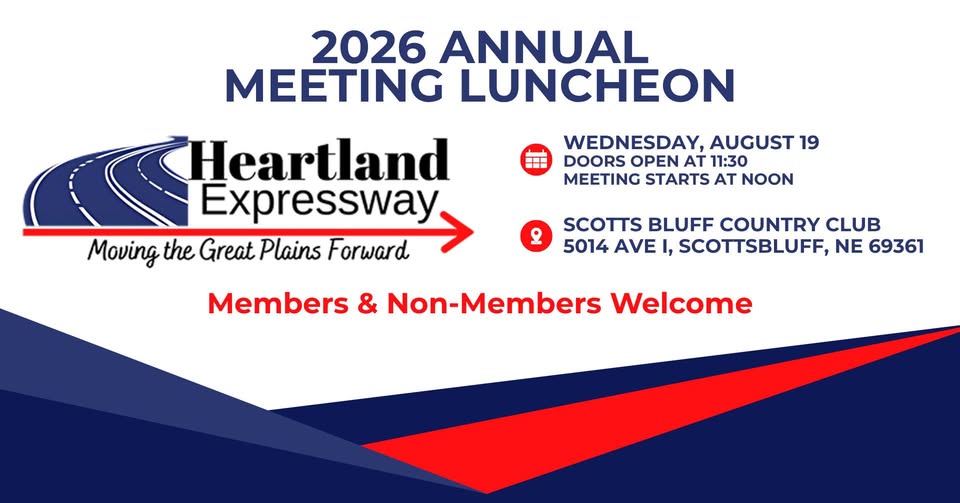
Heartland Expressway 2026 Annual Meeting Luncheon
Join us for the Heartland Expressway 2026 Annual Meeting Luncheon at the Scotts Bluff Country Club. This year's event will feature insights from industry experts, comprehensive progress updates, and messages from elected officials.
Event Details:
Date: Wednesday, August 19
Timeline: Doors open at 11:30 AM; the meeting commences at 12:00 PM
Location: Scotts Bluff Country Club, 5014 Ave I, Scottsbluff, NE 69361
Registration and Cost: - Annual Meeting: Free to attend
- Optional Luncheon: $30 per person
Please note that registration is required for all attendees. The deadline to secure your seat is Monday, August 10.
To register, please complete the online RSVP form: https://forms.gle/CFBoG2KDM8LASpfG9
Scottsbluff, Nebraska
|
2026 Ports-to-Plains Alliance Conference: Bridging from Designation to Delivery
|
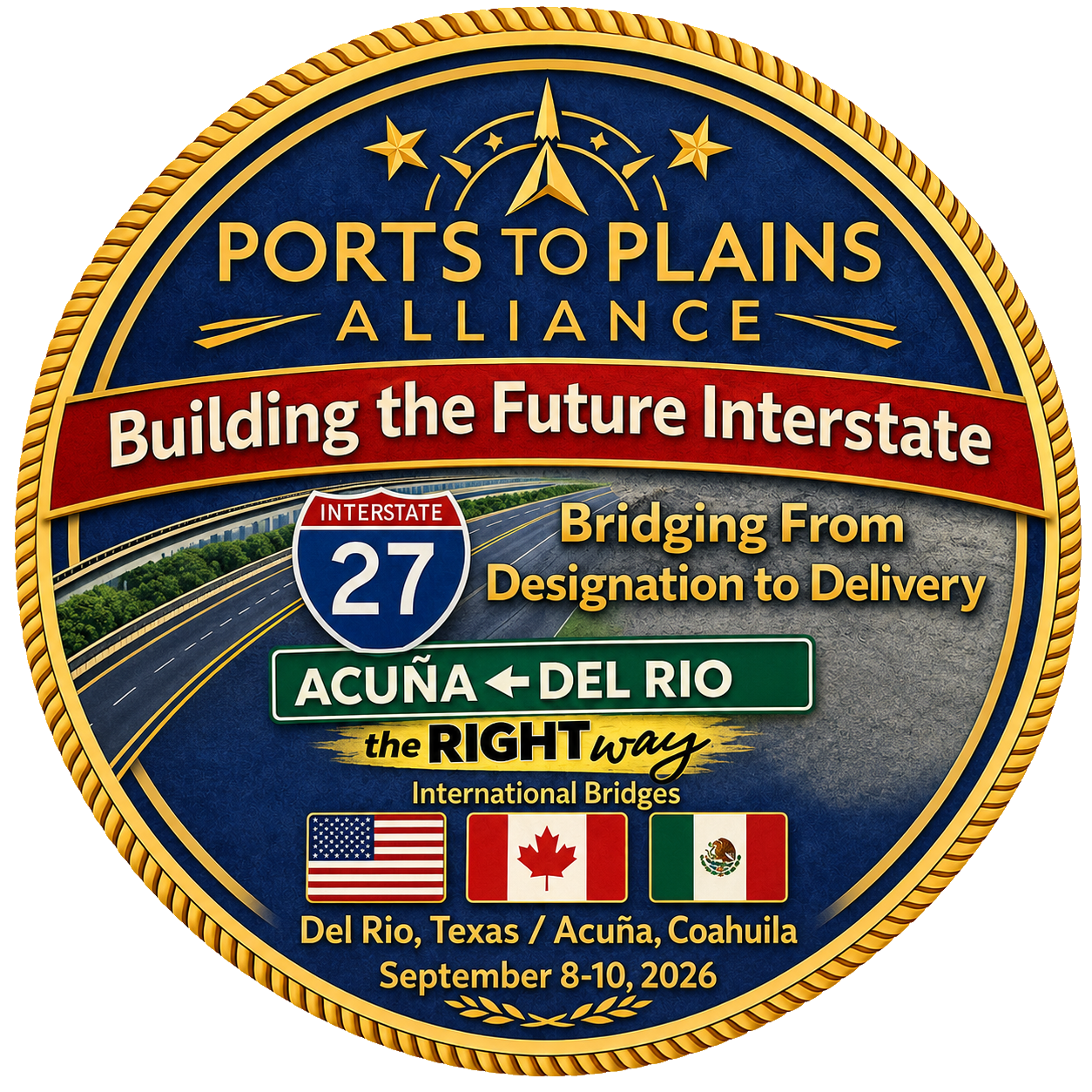
The 2026 Ports-to-Plains Alliance Conference will bring corridor leaders, policymakers, transportation officials, port communities, and industry partners together in Del Rio, Texas, and Acuña, Coahuila, September 8–10, 2026, for a timely binational discussion on the future of interstate development, border commerce, and North American trade.
This year’s conference theme, Building the Future Interstate: Bridging from Designation to Delivery, reflects the next major challenge facing the Ports-to-Plains Corridor. With Future Interstate 27 now congressionally designated, the focus must shift toward implementation: securing funding, advancing project development, strengthening port-to-interstate connections, and building the partnerships needed to deliver a modern interstate corridor from Texas to the broader North American trade network.
The conference will begin Tuesday evening, September 8, with registration and a welcome reception at the Ramada by Wyndham in Del Rio, followed by a kickoff mixer at Gin House Jazz Club featuring live jazz, hors d’oeuvres, and Mariachi Del Rio. On Wednesday, September 9, attendees will travel to Acuña, Mexico, for binational programming and community engagement. Attendees are reminded that a current passport, passport card, Global Entry card, or SENTRI card will be required for the Acuña visit. Translation services will be available during conference programming.
Thursday’s meeting sessions at the Del Rio Civic Center will focus on the major policy, funding, trade, technology, and border-security issues shaping the future of the corridor. The morning program will open with From Trade Route to Strategic Asset: I-27, Border Security, and Emergency Response, emphasizing the role of future interstate connectivity in strengthening border security, emergency response, and national preparedness.
The agenda will then turn to federal policy and funding with From Designation to Delivery: A Federal Funding Pathway for Future Interstates, featuring Jennifer Sheperd, Managing Director and Senior Policy Advisor with Hance Scarborough LLP. This session will examine how federal programs and advocacy strategies can help move future interstate corridors from concept and designation into construction and delivery.
Additional morning sessions will highlight the importance of secure and resilient border infrastructure. ASREC Ports: Advancing Secure, Redundant, and Economic Gateways from Designation to Delivery will focus on the role of Advanced Security, Redundant, and Economic Corridor ports in strengthening trade reliability and border resiliency. The following session, Impact of the Del Rio Port: A Strategic Border Gateway for Trade, Jobs, and Regional Growth, will exlore how the Del Rio Port of Entry supports international commerce, regional economic development, freight movement, and future I-27 connectivity.
The afternoon program will focus on corridor expansion, planning, and trade infrastructure. Bridging Growth: The Economic Case for Extending I-27 Toward the Rio Grande Valley will examine how extending Future I-27 toward the Valley could strengthen access to major border gateways, expand trade opportunities, and support long-term economic growth. Planning the Case for Investment: Future I-27, Port Access, and the Border Master Plan will highlight the importance of using planning tools, stakeholder comments, and the Border Transportation Master Plan process to support the case for interstate and port-access investment.
Later sessions will include Bridging Ports and Corridors: Advancing Cross-Border Trade Infrastructure, with discussion of Del Rio, Puerto Verde, and other port-to-interstate connections; USMCA and the Corridor Economy: Moving Trade from Border to Market, focused on North American trade and supply-chain competitiveness; and Technology-Driven Corridors: Lessons for Moving from Designation to Delivery, featuring Tracy Forester, ITS Practice Leader with Halff.
The conference will close with Building Momentum: Key Takeaways and Action Items, led by Lauren Garduño, President/CEO of the Ports-to-Plains Alliance. This closing session will help identify the next steps needed to advance the corridor, strengthen partnerships, and turn conference discussions into action.
The 2026 conference will conclude Thursday evening with the Main Street Social & Food Truck Fest in downtown Del Rio, celebrating music, food trucks, and border culture.
The Ports-to-Plains Alliance invites members, sponsors, public officials, transportation leaders, economic development professionals, port communities, and industry partners to join us in Del Rio and Acuña as we continue building the future interstate and strengthening North American trade connectivity.
Registration is open. Plan now to join us September 8–10, 2026, in Del Rio, Texas, and Acuña, Coahuila.
Register for the Conference:
https://www.portstoplains.com/events/annual-conference/registration/ View the Schedule & Agenda:
https://www.portstoplains.com/events/annual-conference/schedule/ Become a Sponsor:
https://www.portstoplains.com/events/annual-conference/sponsors/ Book Lodging:
https://www.portstoplains.com/events/annual-conference/lodging/
|
Joe Kiely
Vice President of Operations
Ports-to-Plains Alliance
PO Box 758
Limon, CO 80828
Cell: (719) 740-2240
joe.kiely@portstoplains.com
|
Cal Klewin
Executive Director
Theodore Roosevelt Expressway Association
PO Box 1306
Williston, ND 58802
701-523-6171
cal@trexpressway.com
|
Deb Cottier
Chair
Heartland Expressway Association
c/o TCD
1820 Broadway
Scottsbluff, NE 69341
308-430-5959
dcottier@gpcom.net
|
|