
South Dakota Implementation
South Dakota: Center of the Nation
South Dakota is a vital northern link in the Ports-to-Plains Corridor, connecting the Heartland Expressway and Theodore Roosevelt Expressway through western South Dakota and the Black Hills region. The corridor strengthens north-south mobility between Nebraska, South Dakota, North Dakota, Montana, Wyoming, and the broader Great Plains freight network, while supporting tourism, agriculture, energy, construction, defense access, and rural economic development.
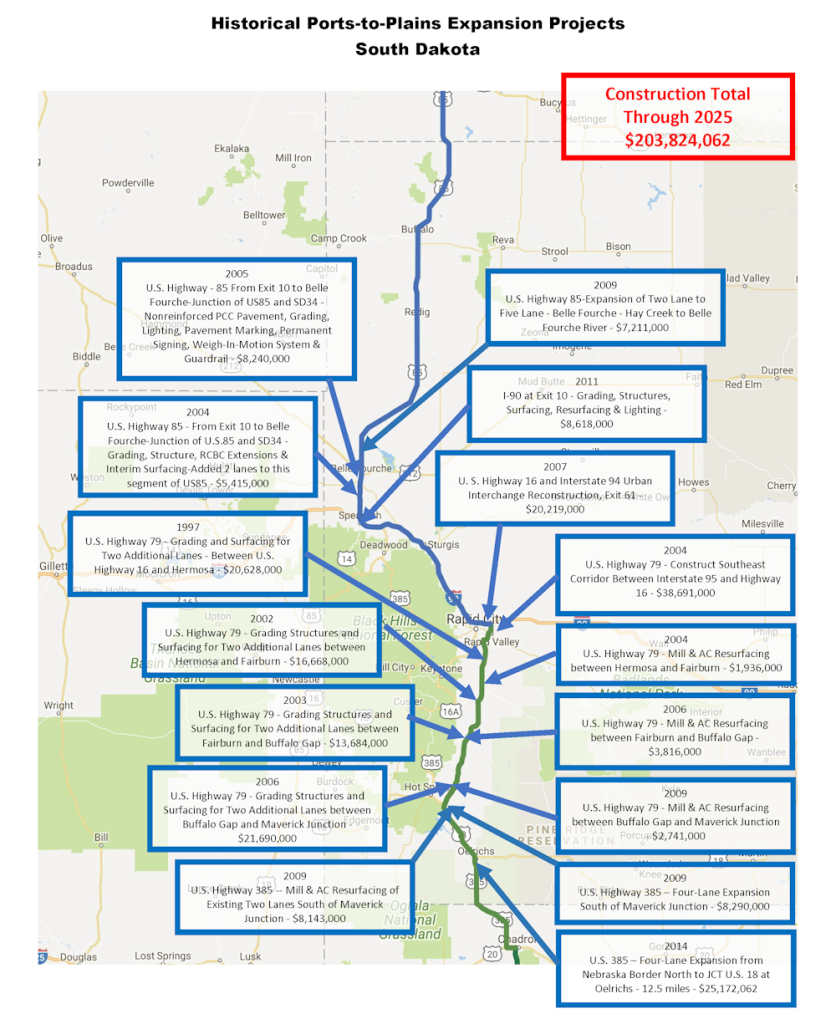
South Dakota has already made significant progress advancing the corridor, completing more than $203.8 million in corridor-related construction improvements through 2025. These projects include added lanes, four-lane expansion, resurfacing, interchange reconstruction, grading, structures, lighting, signing, and safety improvements along key routes including U.S. 79, U.S. 85, U.S. 385, and I-90. Major improvements on U.S. 79 between U.S. 16, Hermosa, Fairburn, Buffalo Gap, and Maverick Junction have helped strengthen the connection between the Nebraska state line, the southern Black Hills, Rapid City, and I-90.
Since 2014, the U.S. 79 corridor from the Nebraska state line to I-90 at Rapid City has become an increasingly important economic spine for western South Dakota. The route supports visitor access to the Black Hills, Wind Cave National Park, Custer State Park, Hot Springs, Hermosa, Rapid City, and I-90 while also serving freight movement, agriculture, construction, emergency response, local commuting, and regional business travel. Continued investment in U.S. 79 and connected corridor routes will improve safety, freight reliability, tourism access, and long-term economic competitiveness across western South Dakota.
Corridor Successes
South Dakota has a strong record of advancing the Heartland Expressway and Theodore Roosevelt Expressway through targeted construction, widening, resurfacing, interchange, and safety investments. Through 2025, the state completed $203,824,062 in historical Ports-to-Plains expansion projects, demonstrating a long-term commitment to improving north-south mobility through western South Dakota and the Black Hills region.
A major success has been the steady improvement of U.S. Highway 79, one of the corridor’s most important north-south routes between the Nebraska state line and Rapid City. South Dakota completed added-lane projects between U.S. 16 and Hermosa, Hermosa and Fairburn, Fairburn and Buffalo Gap, and Buffalo Gap and Maverick Junction, creating a stronger and more reliable corridor through the southern Black Hills region.
South Dakota has also advanced key improvements on U.S. Highway 85 near Belle Fourche, including added lanes, grading, structures, concrete pavement, lighting, pavement markings, permanent signing, guardrail, and weigh-in-motion improvements. These investments strengthened the northern corridor connection toward the Theodore Roosevelt Expressway and improved freight and regional access near Belle Fourche.
Another important success is the improvement of U.S. Highway 385, including four-lane expansion south of Maverick Junction and a 12.5-mile four-lane expansion from the Nebraska border north to U.S. 18 at Oelrichs. These projects strengthened South Dakota’s Heartland Expressway connection to Nebraska and improved access into the Black Hills.
South Dakota’s progress also includes strategic interchange and gateway improvements, including the U.S. 16/I-90 urban interchange reconstruction at Exit 61 and improvements at I-90 Exit 10. These projects improved regional access, safety, and traffic flow at key connections serving Rapid City, Sturgis, tourism traffic, local commuters, and freight movement.
Economic Impact Since 2014:
Highway 79 Corridor,
Nebraska State Line to I-90/Rapid City
Since 2014, the Highway 79 corridor from the Nebraska state line to I-90 at Rapid City has strengthened its role as one of western South Dakota’s most important north-south economic corridors. The route supports tourism access to the Black Hills, Wind Cave National Park, Custer State Park, Hot Springs, Hermosa, Rapid City, and surrounding communities while also serving freight, agriculture, local commuting, construction, emergency response, and regional business travel. At the north end of the corridor, traffic growth demonstrates increasing demand: Rapid City MPO counts show SD-79 between the city limit and Elk Vale increased from 13,938 vehicles per day in 2014 to 15,608 in 2025, while Elk Vale Road between SD-79 and SD-44 increased from 16,868 to 21,471 vehicles per day over the same period. The I-90 segment from Elk Vale to the east city limit also increased from 25,474 vehicles per day in 2014 to 32,957 in 2025, reflecting the corridor’s growing connection to Rapid City, I-90, tourism traffic, and regional development.
Tourism is the clearest economic driver along and near the Highway 79 corridor. In 2024, South Dakota welcomed nearly 15 million visitors, who spent $5.1 billion statewide and generated a total economic impact of $8.1 billion, supporting 58,824 jobs and nearly $400 million in state and local tax revenues. Most visitors arrive by car, making highway reliability and capacity directly tied to tourism spending.
The corridor serves the Black Hills & Badlands tourism region, which generated $1.96 billion in visitor spending in 2024, or 38.5% of statewide visitor spending. Within the Highway 79 corridor area, Pennington County generated $985.9 million in visitor spending, Custer County generated $145.2 million, and Fall River County generated $39.5 million. Tourism supported 11,269 total jobs in Pennington County, 1,238 in Custer County, and 537 in Fall River County.
Traffic counts show the northern end of the corridor is carrying heavier volumes than it did in 2014. Rapid City MPO’s 2014 report listed SD-79 from the city limit to Elk Vale at 13,938 vehicles per day, Elk Vale from SD-79 to SD-44 at 16,868, Elk Vale from SD-44 to I-90 at 18,808, and I-90 from Elk Vale to the east city limit at 25,474.
By 2025, those same or related north-end connections had increased to 15,608 on SD-79 from the city limit to Elk Vale, 21,471 on Elk Vale from SD-79 to SD-44, 22,009 on Elk Vale from SD-44 to I-90, and 32,957 on I-90 from Elk Vale to the east city limit. That represents roughly 12% growth on SD-79, 27% growth on Elk Vale between SD-79 and SD-44, 17% growth on Elk Vale between SD-44 and I-90, and 29% growth on I-90 east of Elk Vale from 2014 to 2025.
Highway 79 also supports freight movement between the Nebraska line, Fall River County, Custer County, Pennington County, Rapid City, I-90, and the broader Ports-to-Plains system. South Dakota’s freight plan emphasizes that freight movement is vital to the state economy and that many of the state’s top commodities moving to and from South Dakota are tied to agriculture. The plan also notes that trucks dominate freight movement in South Dakota, accounting for 63% of freight by weight and 71% of freight by value in 2020, with Nebraska identified among South Dakota’s top domestic trading partners.
For the Highway 79 corridor, that means improved reliability benefits livestock, grain, construction materials, fuel, supplies for tourism businesses, and service traffic moving between Nebraska, the southern Black Hills, Rapid City, and I-90. The route also helps connect rural producers and small communities to regional markets, medical services, airports, suppliers, and workforce centers.
Safety remains a key reason to continue improving the corridor. County-level crash data shows the corridor counties carry significant safety exposure. In 2024, Pennington County accounted for 156 rural fatal and injury crashes, or 11.7% of all rural fatal and injury crashes in South Dakota, while Custer County accounted for 52 rural fatal and injury crashes, or 3.9%. Rapid City also reported 1,558 total crashes, including 5 fatal crashes, 505 injury crashes, and 1,048 property-damage-only crashes.
Because Highway 79 serves tourism traffic, local commuters, trucks, RVs, motorcycles, agricultural vehicles, and seasonal recreation traffic, safety improvements have value beyond crash reduction. Wider shoulders, better intersections, passing opportunities, pavement preservation, signing, and emergency access all support safer travel for residents, visitors, and freight carriers.
The Highway 79 corridor also supports emergency response and disaster mobility, especially for wildfires, winter storms, crashes, and evacuation routes serving rural communities and the Black Hills. It provides a practical alternate north-south connection to U.S. 385 and U.S. 16, helping distribute tourism traffic and maintain access when incidents or weather affect other routes. It also supports workforce access into Rapid City and the growing eastern side of the metro area, including connections to I-90, Rapid City Regional Airport, and regional employment centers.
What Is Coming?
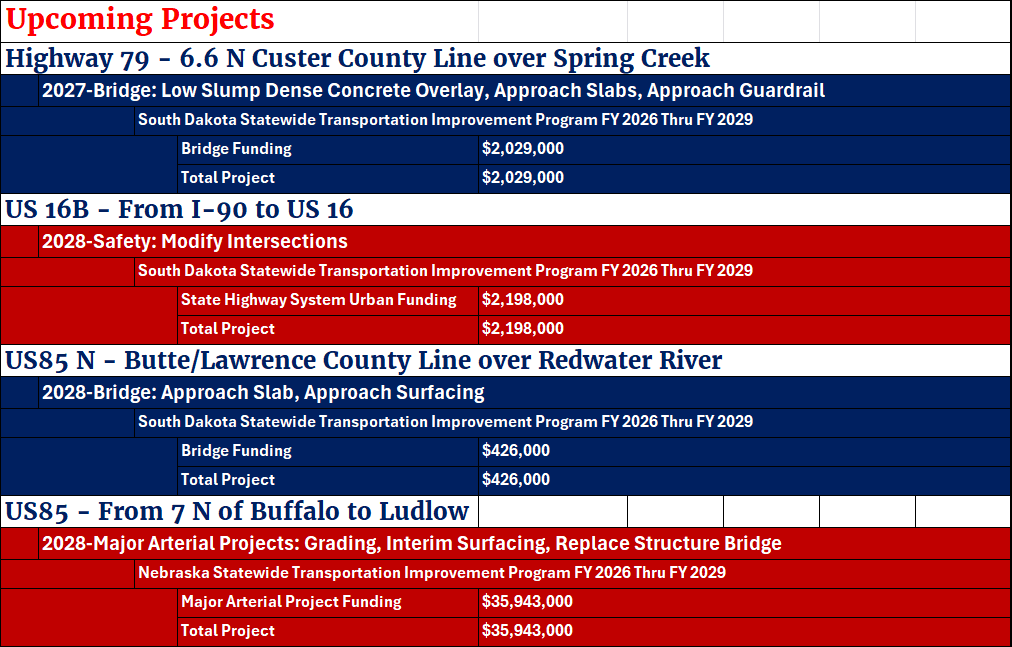
Two major U.S. Highway 85 expansion projects in North Dakota reached a key milestone with successful bid openings in November 2025, advancSouth Dakota’s next step is to build on its proven record of corridor investment and prepare the system for future interstate development. With more than $203.8 million in completed corridor construction already delivered, South Dakota has strengthened key Ports-to-Plains routes including U.S. 79, U.S. 85, U.S. 385, and I-90. The next phase is already taking shape through more than $40.5 million in upcoming FY 2026–2029 projects, including bridge, safety, urban highway, and major arterial improvements. Planned projects include a Highway 79 bridge improvement over Spring Creek north of the Custer County line, a U.S. 16B safety project from I-90 to U.S. 16, a U.S. 85 bridge-related improvement over the Redwater River at the Butte/Lawrence County line, and a major U.S. 85 project from north of Buffalo to Ludlow involving grading, interim surfacing, and bridge replacement. These investments will improve safety, freight reliability, tourism access, bridge condition, emergency response, and regional mobility across western South Dakota. Continued state and federal support will help South Dakota strengthen rural economic competitiveness and position the Heartland Expressway and Theodore Roosevelt Expressway for future interstate designation and funding opportunities.ing nearly 20 miles of corridor improvements south of the Long X Bridge to ND Highway 200. Funded through a combination of state and federal resources under Senate Bill 2012, the projects total approximately $155 million and continue the state’s long-term effort to upgrade the corridor to a four-lane divided facility.
The first segment, extending from Reference Post 120.3 to the Long X Bridge in McKenzie County, attracted five competitive bids ranging from $83.8 million to $102 million, with the apparent low bid submitted by Park Construction Company. The second segment, from RP 120.3 to ND 200, includes approximately 12 miles of reconstruction with intersection upgrades, drainage improvements, and enhanced safety features, supported by a $55 million federal Rural Surface Transportation Grant match.
Both projects build upon a completed 2019 FEIS/ROD and are designed to improve safety, capacity, and system reliability while addressing geotechnical and environmental considerations. Construction is anticipated to occur over two seasons in 2026 and 2027, marking another significant step toward full corridor modernization and future Interstate readiness. In parallel, the North Dakota Legislature has already directed the North Dakota Department of Transportation (NDDOT) to initiate environmental review work on the remaining U.S. 85 segment between Interstate 94 and the North Dakota–South Dakota state line as the Long X Bridge to ND 200 improvements near completion—ensuring continuity of planning and positioning the corridor for future investment and development.
Key South Dakota
State Funding
South Dakota transportation improvements are funded through a combination of state highway funds, federal-aid highway programs, local-government programs, and targeted funding categories that support major arterials, urban state highways, bridges, safety, and system preservation. For the Corridor, the most important funding categories include Major Arterial Projects, State Highway System Urban, Highway Safety Improvement Program, bridge replacement and structure funding, Surface Transportation Block Grant Program, and National Highway Performance Program. These programs are critical tools for advancing improvements on U.S. 79, U.S. 85, U.S. 385, and I-90. Continued use of these funding categories will help improve freight reliability, tourism access, bridge condition, safety, emergency response, and future interstate connectivity cross western South Dakota.
Economic Benefits
Continued development of the Heartland Expressway and Theodore Roosevelt Expressway will strengthen South Dakota’s economy by improving access to markets, visitor destinations, freight routes, agriculture, energy development, and regional business centers. These corridors connect western South Dakota to Nebraska, Colorado, North Dakota, Montana, Canada, I-90, and the larger Ports-to-Plains system, giving South Dakota a stronger north-south trade and tourism route through the Great Plains.
For South Dakota, the economic value is especially clear in the Black Hills and Rapid City region, where reliable highway access directly supports tourism, lodging, restaurants, fuel sales, retail, attractions, construction, and local tax revenue. South Dakota tourism reported that visitor spending increased in all four state tourism regions in 2024, including growth in the Black Hills and Badlands region. Continued corridor improvements will help move visitors more safely and efficiently to Rapid City, Hot Springs, Wind Cave National Park, Custer State Park, Sturgis, Belle Fourche, and other Black Hills destinations.
The corridors also strengthen South Dakota’s freight and agricultural economy. The South Dakota Freight Plan is intended to guide improvements to the state’s freight system and support a safe and effective transportation network, including maintaining pavement and bridge conditions on the state’s preferential truck network and National Highway System. Improvements to U.S. 79, U.S. 85, U.S. 385, and I-90 connections will support the movement of livestock, grain, fuel, construction materials, manufactured goods, tourism supplies, and regional distribution traffic.
South Dakota has already built a strong foundation. These investments included added lanes, four-lane expansion, resurfacing, interchange reconstruction, grading, structures, lighting, signing, and safety improvements on U.S. 79, U.S. 85, U.S. 385, and I-90 connections. Continued development will build on those successes by improving freight reliability, reducing travel delays, supporting business growth, expanding tourism access, and positioning South Dakota for future interstate-level investment.

Support in the South Dakota Legislature
Continued support from the South Dakota Legislature is needed to build on the state’s proven record of Ports-to-Plains Corridor investment and keep the Heartland Expressway and Theodore Roosevelt Expressway moving forward. Sustained legislative support will help protect these investments, leverage federal funding, advance planning and construction, and prioritize improvements that strengthen freight reliability, Black Hills tourism access, agriculture, safety, emergency response, and rural economic development. By supporting continued corridor development, South Dakota lawmakers can help position the state for future interstate-level connectivity and long-term economic growth.