
Oklahoma Implementation
Strategic Investment – Oklahoma’s Freight Future
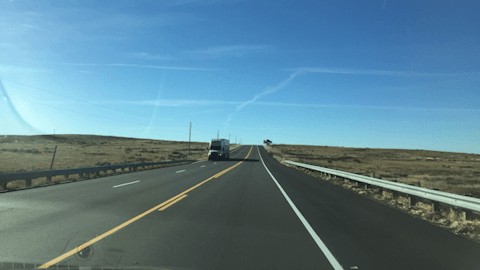
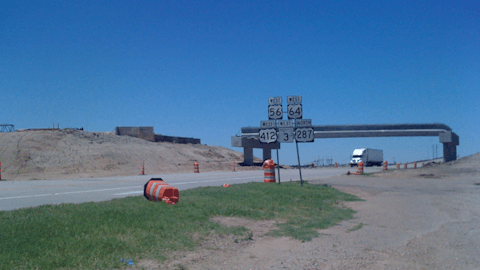
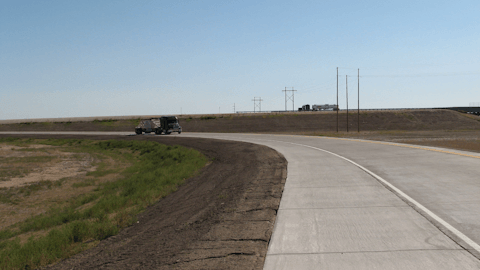
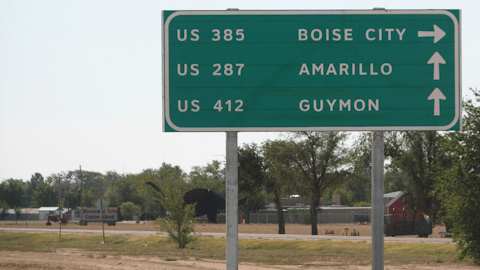
The Boise City Relief Route on U.S. 287, completed in 2011, reroutes through traffic—especially heavy truck volumes—around the center of Boise City, improving safety, mobility, and quality of life in the community. By diverting freight traffic away from local streets and intersections, the project reduces congestion, minimizes conflict points, and enhances overall traffic flow along this key north–south corridor. U.S. 287 extends approximately 40.8 miles through Oklahoma, from the Texas state line to the Colorado state line, and the relief route serves as a critical improvement within this segment—supporting more efficient regional freight movement and positioning the corridor for future capacity upgrades and long-term development.
Corridor Successes
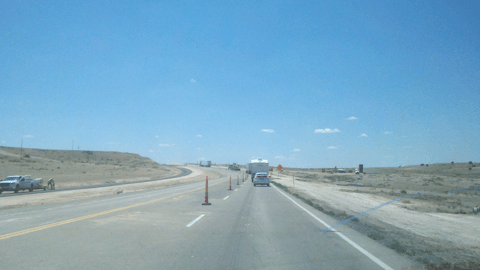
Oklahoma has made steady, incremental improvements to U.S. 287 since the late 1990s, but the scale of investment has been relatively modest compared to other Ports-to-Plains corridor states. Rather than full corridor conversion, most work has focused on targeted safety and operational upgrades—particularly widening shoulders, adding passing lanes (Super-2 treatments), intersection improvements, and pavement rehabilitation to support heavy freight traffic moving between Texas and the Oklahoma Panhandle.
Since 1997, cumulative investment in U.S. 287 in Oklahoma is generally estimated in the tens of millions of dollars, not hundreds of millions, reflecting the state’s approach of phased improvements rather than full four-lane expansion. Key projects have included rural shoulder widening to improve safety, localized passing lane additions to reduce head-on crash risk, bridge and pavement upgrades to maintain freight reliability, and intersection improvements near communities such as Boise City. These efforts have improved corridor performance, but large portions of U.S. 287 in Oklahoma remain two-lane facilities without full access control.
The result is a corridor that functions better than it did in the 1990s but still lacks the capacity, safety performance, and reliability needed for long-term freight growth. Compared to neighboring states like Texas and Colorado, Oklahoma’s investment has not yet advanced U.S. 287 toward a continuous four-lane or Future Interstate-ready facility, reinforcing the need for sustained policy focus and increased funding to fully realize the corridor’s economic and regional connectivity potential.
What Is Coming?
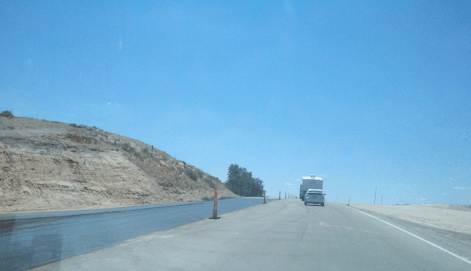
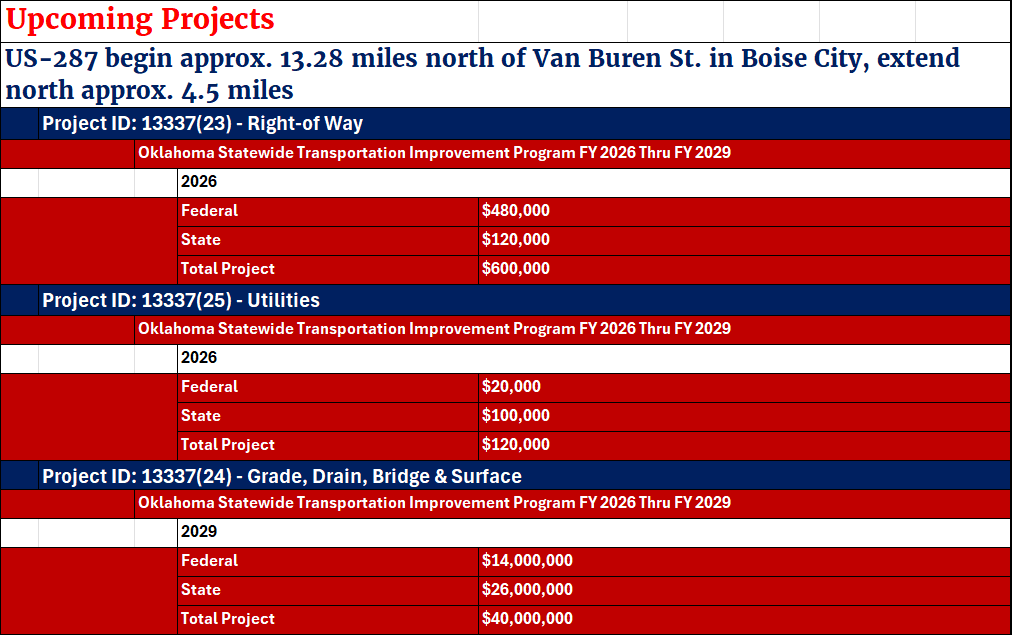
The FFY 2026–2029 Oklahoma STIP confirms that ODOT has three programmed phases for the next U.S. 287 project north of Boise City in Cimarron County. The project begins approximately 13.28 miles north of Van Buren Street in Boise City and extends north approximately 4.5 miles. The right-of-way and utility phases are programmed in FFY 2026, and the full construction phase is programmed in FFY 2029.
Key Oklahoma
State Funding
Oklahoma’s investment in U.S. 287 has been supported primarily through state transportation funding programs administered by the Oklahoma Department of Transportation, with a focus on incremental safety and capacity improvements across the Oklahoma Panhandle. The State Highway Construction and Maintenance Fund serves as the primary source of funding, supporting projects such as shoulder widening, passing lane additions, pavement rehabilitation, and intersection upgrades along the corridor. These investments have been programmed through Oklahoma’s 8-Year Construction Work Plan, allowing the state to advance projects as funding becomes available. In addition, Rebuilding Oklahoma Access and Driver Safety (ROADS) Fund revenues—derived from motor fuel tax and vehicle fee increases—have helped stabilize long-term transportation funding and support rural corridor improvements, including segments of U.S. 287. Federal-aid programs such as the National Highway Performance Program (NHPP) and Surface Transportation Block Grant (STBG) are typically paired with state funds to deliver projects, with the state providing required matching funds. While investment levels have been more incremental compared to other corridor states, these combined funding sources have enabled Oklahoma to improve safety, maintain freight reliability, and position U.S. 287 for future expansion.

Economic Benefits
Expanding U.S. 287 in Oklahoma would deliver important economic benefits by strengthening the Panhandle’s primary north–south freight connection between Texas, Oklahoma, and Colorado. The corridor supports long-distance truck movement, agriculture, energy production, and regional trade, making reliability and safety critical for businesses that depend on efficient access to markets. Continued widening, Super 2 improvements, right-of-way preservation, and future four-lane development would reduce travel delays, improve passing opportunities, and lower crash risks for heavy truck traffic moving through Cimarron County and Boise City.
For the Oklahoma Panhandle, U.S. 287 expansion also supports local economic competitiveness. Better highway access helps farms, ranches, grain handlers, energy firms, equipment suppliers, and logistics providers move products and materials more efficiently. Improvements around Boise City, including the reliever routes, already demonstrate how corridor investments can reduce truck conflicts in town while improving community safety and mobility. Future expansion north of Boise City would build on that progress by improving freight reliability and positioning the corridor for long-term growth.
At the broader corridor level, U.S. 287 is Oklahoma’s key link in the Ports-to-Plains system, connecting the state to major trade routes serving Canada, the central United States, Texas, and Mexico. Expanding the corridor improves supply chain resilience, supports agricultural exports, enhances access to regional labor and services, and helps rural Oklahoma compete for private investment. Sustained investment in U.S. 287 would not only improve transportation performance; it would help convert Oklahoma’s Panhandle location into a stronger economic advantage.
Support in the Oklahoma Legislature
Now is the time to keep U.S. 287 moving forward in Oklahoma. Urge members of the Oklahoma Legislature to continue supporting sustained investment in U.S. 287 through the Oklahoma Panhandle, including right-of-way preservation, utility relocation, safety improvements, Super 2 upgrades, and future four-lane expansion. Continued legislative support will help ODOT advance projects from planning to construction, improve freight mobility between Texas and Colorado, reduce safety conflicts through Boise City and Cimarron County, and strengthen Oklahoma’s role in the Ports-to-Plains Corridor. Long-term funding commitment is essential to deliver a safer, more reliable corridor that supports agriculture, energy, trade, and economic growth across the Panhandle.