
Future Interstate Feasibility
What is an Interstate Feasibility Study?
Advancing the Future Interstate Corridor requires more than designation—it requires rigorous, data-driven planning supported by broad stakeholder input. The proposed I-27 Interstate Feasibility Study Authorization Act of 2026 establishes a comprehensive federal framework to evaluate the technical, economic, and logistical feasibility of extending I-27 across the multi-state corridor. In addition to engineering, cost, freight, safety, and national defense analysis, the legislation creates a formal Interstate Feasibility Advisory Committee and state-based Segment Committees to ensure coordinated, ground-up participation. These committees bring together state DOTs, local governments, industry, economic development leaders, and corridor communities to provide structured input and priorities for each segment. Authorized by Congress and led by a designated lead state, the study delivers the objective analysis and multi-state consensus required to advance Future Interstate segments from concept to eligibility for federal funding and construction—transforming designation into a deliverable national corridor.
National Connectivity
National Connectivity is a core federal transportation responsibility that requires sustained national leadership, long-term planning, and investment aligned with the country’s evolving economic and security needs. A strong federal role ensures surface transportation policy advances the national interest, uses taxpayer funds efficiently, and supports an integrated network capable of handling interstate travel and commerce. Effective connectivity depends on seamless network flows across states, coordination with other passenger and freight modes, and access to emerging population and economic centers that drive growth and competitiveness. | Equally important, a nationally connected transportation system must be resilient and secure. Redundancy within the network strengthens reliability during disruptions, while strategic design and investment ensure responsiveness to national defense requirements. Together, these principles reinforce the need for a connected, adaptable surface transportation system that supports mobility, trade, and security across the United States.
Connecting the Corridor
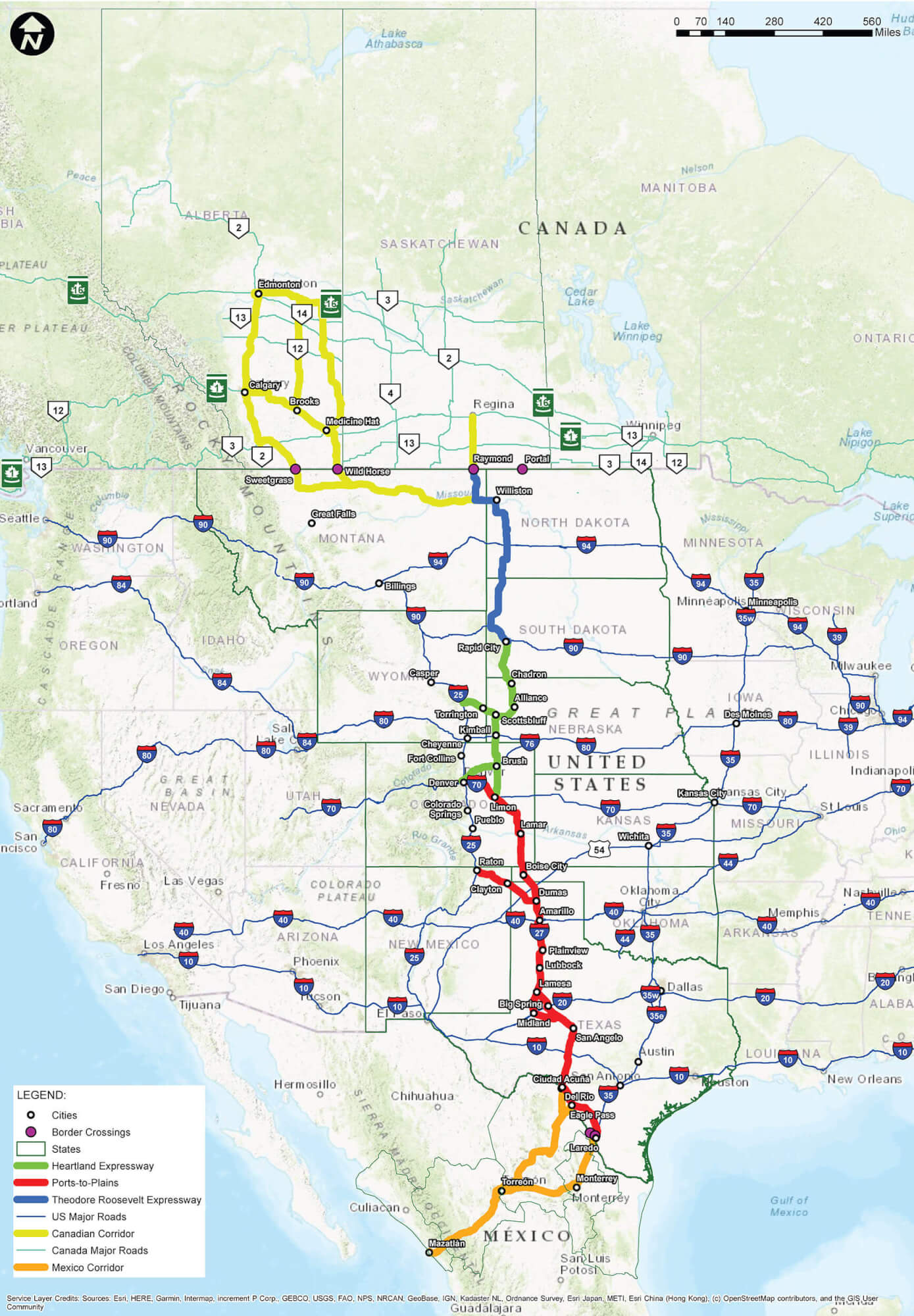
Connecting the Corridor is essential to achieving Future Interstate status and delivering true national connectivity. To qualify, the corridor must link existing interstate highways, creating a continuous, multi-state network that integrates I-27 in Texas with I-70 and I-76 in Colorado, I-80 in Nebraska, I-25 in Colorado and Wyoming, I-90 in South Dakota, and I-94 in North Dakota. | A unified, multi-state Interstate Feasibility study allows Texas, New Mexico, Colorado, Oklahoma, Nebraska, Wyoming, South Dakota, North Dakota, and Montana to coordinate planning, design, and investment decisions. This coordinated approach ensures seamless Interstate connections, consistent standards, and efficient delivery across state lines—transforming individual highway segments into a nationally connected Future Interstate Corridor.
Connecting the I-27 Feasibility Study to the Existing I-27 System
The proposed I-27 Interstate Feasibility Study Authorization Act of 2026 builds directly on the established and expanding I-27 system in Texas, where significant federal and state investments have already transformed large portions of the Ports-to-Plains Corridor into Interstate-standard facilities. As documented in the Texas I-27 system plan, Texas has advanced corridor development through phased construction, upgrades, and formal interstate designation, demonstrating both feasibility and demand. The proposed feasibility study extends this proven model beyond Texas, using the existing I-27 backbone as the southern anchor for a continuous, multi-state Future Interstate Corridor. By connecting the completed and planned Texas and New Mexico segments to Oklahoma, Colorado, Nebraska, Wyoming, South Dakota, North Dakota, and Montana, the study ensures prior investments are fully leveraged, gaps are addressed systematically, and I-27 functions as a true national interstate route rather than a standalone state facility.

Advocate for the Future Interstate Study
Now is the time to secure data-driven progress for the Future Interstate Corridor. Urge your Members of Congress to include and advance the I-27 Interstate Feasibility Study Authorization Act of 2025 within the next Federal Transportation Reauthorization bill. This inclusion is essential to authorize funding, guide investment decisions, and move Future Interstate segments toward construction.